Your Shenzhen→New York Container Just Got Faster. Here's What Panama's 1-Foot Draft Change Actually Means For You
If you've been shipping from Shenzhen or Shanghai to New York, Norfolk, Savannah, or Houston over
the last 18 months, you probably remember the pain:
- Your container got to the Panama Canal and waited 6 to 12 days for a transit slot
- Your ship was forced to light-load (carry fewer containers than it could) because the canal was too shallow
- Your freight bill included a "Panama Canal transit surcharge" that seemed to grow every month
- You started rerouting everything to Los Angeles/Long Beach, then paying for a 5-day rail trip across the country to New York
That era is quietly ending.
On September 28, 2026, the Panama Canal Authority (ACP) relaxed its most restrictive draft limit in decades. And starting October 15, more daily transit slots open up. At almost exactly the same time, COSCO Shipping Lines went on a US East Coast expansion spree — adding new direct services from Tianjin, Nanjing, and Yangpu, all transiting the Panama Canal directly to New York, Norfolk, Savannah, and Houston.
If you're a China-based importer or cross-border seller moving cargo to the US East Coast, these two events combined mean one thing: your Shenzhen→New York shipments are about to get faster, more reliable, and (eventually) cheaper.
Let me break down what's actually happening — and, just as importantly, what isn't happening.
What Changed at the Panama Canal?
Most freight articles throw around "draft restrictions" and "transit slots" without explaining what they actually mean for your cargo. Let me decode it.
Draft = how deep a ship sits in the water. When the canal's Gatun Lake is low (it's fed by rain), ships are forced to sail with less weight — fewer containers, less fuel, less cargo. That's called "light-loading" or "reduced draft."
Here's the change, effective September 28:
| Parameter | Before (Drought) | After (Sept 28 / Oct 15) | Full Normal Level |
|---|---|---|---|
| Neopanamax max draft | 48 feet (14.63m) | 49 feet (14.94m) | 50 feet (15.24m) |
| Daily Neopanamax slots | 9 ships/day | 10 ships/day | 10+ |
| Total daily slots | 32 ships/day | 33 ships/day | 36+ |
| Weekly large-ship transits | ~63/week | ~70/week | ~80/week |
Why does 1 foot matter so much?
For a 14,000 TEU Neopanamax vessel, that extra 1 foot of draft means the ship can carry roughly 250 to 350 additional containers per transit. Multiply that by 7 extra transits per week — that's roughly 1,750 to 2,450 extra container slots per week opening up on Asia→US East Coast routes.
That's not a massive surge of capacity, but it's enough to take the edge off the "no space" panic.
But — and this is the critical caveat — the drought isn't over. It's a seasonal recovery. The ACP still requires advance booking, ships still compete for slots via auction, and a long-term tender process is now in place to lock in 2027 dry-season capacity. If rainfall in the watershed drops again between now and next May, the ACP can tighten these limits overnight.
What Is COSCO Doing? The US East Coast Power Play
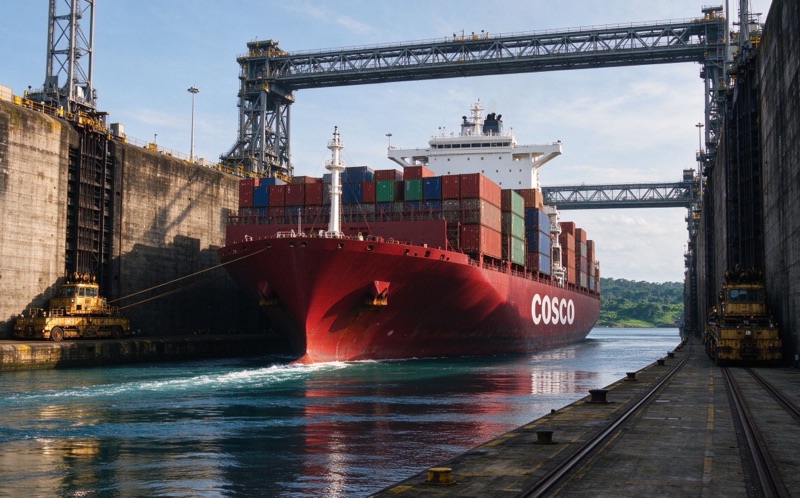
While the canal was tightening, COSCO was quietly building out its entire US East Coast network. Now that water levels are recovering, they're turning on the taps.
Here's what's actually new in 2026:
1. Existing AWE series upgraded with larger ships.
COSCO's core Asia→US East Coast AWE (Atlantic Westbound Express) service is now deploying
14,000 TEU Neopanamax vessels — the largest ships that can physically fit
through the new Panama locks. With draft back to 49 feet, these ships sail fully loaded instead of
light-loaded.
2. New direct services from Chinese ports.
COSCO has launched new direct US East Coast and US Gulf services from:
- Tianjin (Xingang)
- Nanjing (Longtan)
- Yangpu (Hainan)
These ships go direct through the Panama Canal to:
- New York / New Jersey
- Norfolk, Virginia
- Savannah, Georgia
- Houston, Texas
3. The Ocean Alliance context.
This isn't just COSCO. It's the Ocean Alliance (COSCO + OOCL + Evergreen) aligning
capacity with the improved canal conditions. The alliance wouldn't have committed 14,000 TEU ships
to this lane if draft limits were still stuck at 48 feet — that would mean sailing half-empty
and losing money on every voyage.
Why this matters for you as a Shenzhen-based shipper:
Before this expansion, most China→US East Coast cargo either:
- Went via US West Coast (LA/Long Beach) + rail to the East Coast (5–7 days inland rail)
- Went via Singapore or transshipment ports + Panama Canal (adds 5–8 days)
- Went via Suez Canal (when Red Sea security allowed)
Now, with direct COSCO services and improved canal transit, a container from Shenzhen/Yantian can reach New York in roughly 28–32 days — compared to 35–40 days via a transshipment, or 25–30 days via West Coast + rail (but with rail congestion risk).
That's the 4–7 day saving forwarders are quietly quoting to their best customers right now.
What This Means for Shenzhen→New York Importers (The Real Impact)
Let's translate all this news into the three things you actually care about:
1. Transit time: faster on direct services.
If your cargo fits on a COSCO, OOCL, or Evergreen Neopanamax service that transits the canal
directly, expect 3–5 days shorter transit vs. a year ago. The biggest
improvement is for cargo ending up in New York, Norfolk, or Savannah — not LA.
2. Space reliability: less "rolls" during peak.
Before, ships arriving at the canal with full loads sometimes had to leave containers behind
("rolling") because they couldn't get a slot or couldn't carry full draft. With an extra slot per
day and deeper draft, expect fewer rolled containers in Q4 2026 and Q1 2027.
3. Rates: the surcharge comes down first, base rate later.
Don't expect base ocean freight rates to crash overnight. Here's the timeline most forwarders
expect:
- Q4 2026: Panama Canal transit surcharges (currently $150–$300/container) start softening
- Q1 2027: If dry season rainfall holds, base rates on Asia→US East Coast dip 5–10%
- Mid-2027: If the canal stays at 49–50 feet and more alliance ships enter the lane, rates could approach 2019–2020 pre-drought levels
If you're planning a Q4 or Q1 shipment, lock your rate now — don't wait for the bottom.
The Risks No One Is Talking About
Here's where the forwarder commentary stops and the real advice begins. Four things can still go wrong:
1. The canal can tighten again.
This is a seasonal recovery, not a permanent fix. If the 2026–2027 dry season
(January–April 2027) is as dry as 2023–2024, the ACP will reduce draft back to 48 or
even 47 feet. Your "fast direct service" becomes a queue again.
2. US East Coast port congestion is independent.
The canal getting better doesn't mean New York, Savannah, or Houston docks are less congested. US
East Coast ports have their own labor disputes, yard capacity issues, and rail gate problems. A
container that transited the canal in 14 days can still sit at New York dock for 5–7 days
waiting for a chassis or rail connection.
3. Red Sea / Suez dynamics.
If Houthi attacks resume or Suez security deteriorates, ships that were rerouting around South
Africa come back through Suez, and the Asia→US East Coast lane gets more capacity,
not less — which actually helps rates. But if Red Sea opens up fully, some of the Panama-bound
capacity shifts back. This is a moving target.
4. Don't chase the absolute lowest rate.
When capacity loosens, every booking portal will advertise "$1,200 to New York." That rate often
comes with:
- No transit guarantee (your container waits at the canal)
- No rolled-container protection
- No US customs coordination
- No chassis booking at destination
For most Amazon sellers, brand owners, and mid-sized importers, the cheapest rate isn't the cheapest shipment.
Shenzhen to New York: Which Routing Should You Pick?
If you're shipping from Shenzhen, Yantian, Guangzhou, or Foshan to New York in 2026–2027, you've got three real options:
| Routing | Transit Time | Best For | Watch Out For |
|---|---|---|---|
| Direct via Panama Canal (COSCO/OOCL/Evergreen Neopanamax) |
28–32 days | Full containers, time-sensitive retail, Q4 peak | Canal slot availability, dry-season draft |
| US West Coast (LA/LB) + rail to NY | 25–30 days total | Absolute fastest, high-value cargo | Rail congestion, chassis shortages, dock strikes |
| Consolidated LCL via transshipment | 35–45 days | Small shipments (<15 CBM), budget buyers | Multiple handling points, damage risk |
For most cross-border sellers moving 5 CBM to 20 CBM per week into New York, New Jersey, Pennsylvania, or Connecticut — the sweet spot right now is LCL consolidation onto a direct Panama service through a forwarder who has allocated slots. You get the direct routing speed without committing to a full container.
The Bottom Line
The Panama Canal easing and COSCO's US East Coast expansion aren't just shipping-industry news. They directly change your math for any cargo moving from China to the US East Coast in the next 6 months.
What's real:
- Faster direct Shenzhen → New York / Norfolk / Savannah / Houston service
- More weekly capacity on Neopanamax ships
- Lower (and eventually falling) Panama surcharges
What's hype:
- Rates won't drop overnight
- The drought isn't permanently over
- East Coast port congestion is a separate problem
The importers who win in 2027 won't be the ones who waited for the cheapest rate. They'll be the ones who:
- Book early before Q4 peak
- Use a forwarder with direct alliance slot allocation (not a booking portal)
- Understands the difference between "canal transit time" and "total door-to-door time"
- Has US destination customs and last-mile handling sorted
Related Reading
Shipping to Australia instead of the US? ANL just launched a new ACX China–Australia direct service. Read our guide on what the 2026 ANL expansion means for Shenzhen→Fremantle (Perth) sea freight .
Related Reading
Short on time? Need your cargo in 5–10 days? If your shipment is under 500 kg or time-critical, air freight DDP is the faster option. Read our guide on block space agreements vs loose air cargo — and when DDP air freight from China to Europe actually wins .
Shipping From Shenzhen to New York? Get the Direct Panama Canal Rate.
At STU Supply Chain, we hold direct alliance slot allocation on COSCO, OOCL, and Evergreen Neopanamax services from Shenzhen/Yantian to New York, Norfolk, Savannah, and Houston. We handle FCL, LCL, US customs clearance, and door-to-door DDP delivery to your warehouse in New Jersey, Pennsylvania, or anywhere on the US East Coast.
Get Your Shenzhen → New York Sea Freight Quote →FCL • LCL • DDP door-to-door • Direct Panama Canal transit • Weekly departures
Got questions about whether your cargo should go direct via Panama, through US West Coast rail, or by LCL consolidation? Drop your commodity, volume, and US destination in the comments — I'll tell you the fastest and most cost-effective routing.


Comments
Post a Comment