Block Space Agreement vs Loose Air Freight: The China–Europe Pallet Math That Saves (or Costs) You Thousands
If you've ever shipped air freight from China to Europe, you've heard the two magic words: "we have block space."
It sounds exclusive. It sounds like a secret handshake between a freight forwarder and an airline. It also sounds expensive — or, depending on who's talking, suspiciously cheap.
Here's the uncomfortable truth most forwarders won't tell you: a Block Space Agreement (BSA) can be the cheapest way to move cargo from Shanghai to Frankfurt — or it can drain your margin so quietly you don't notice until quarter-end.
I've spent years on the China–Europe air lanes. I've seen forwarders make a killing locking in BSA rates during peak season. I've also seen smaller operators lose €20,000 in a single off-peak month because they signed a 12-month pallet contract when spot rates crashed to half the pivot cost.
This guide breaks down exactly how BSA works, how to calculate your real break-even weight, the four hidden fees nobody quotes you, and — most importantly — when loose (consolidated) air freight through a DDP forwarder is actually the smarter move.
What Is a Block Space Agreement, Anyway?
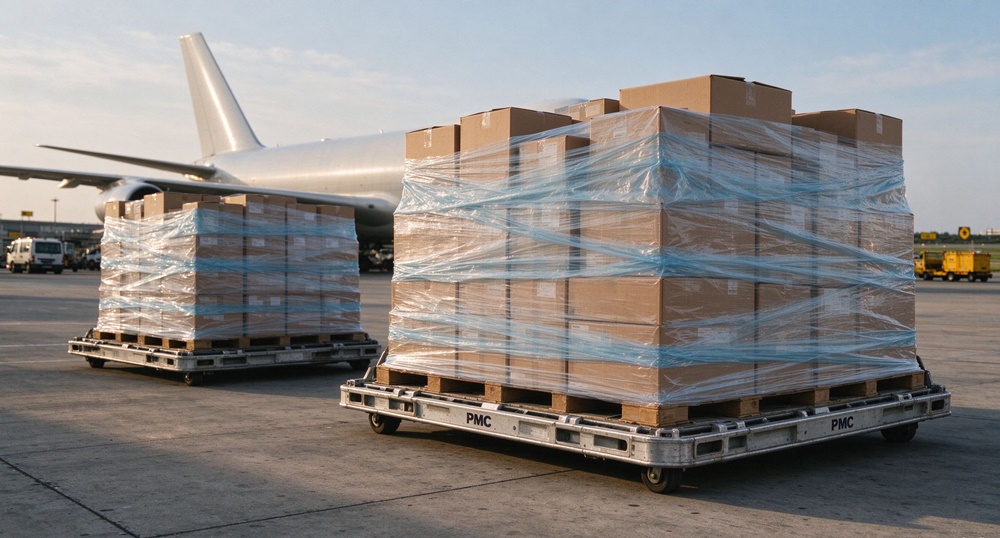 |
| Freight forwarder stacking ULD pallets at Shanghai Pudong airport bound for Frankfurt |
A BSA — Block Space Agreement — is a long-term contract between a freight forwarder and an airline. You commit to a fixed number of ULD pallets (Unit Load Devices) per week, usually for six to twelve months. In return, the airline gives you a contract rate well below the spot market price.
Let's make it concrete.
Take the popular Shenzhen → Frankfurt lane. Right now, spot (loose) air freight for +100 kg shipments runs around ¥28/kg.
Now imagine you sign a BSA for one PMC pallet (244 cm × 318 cm) at ¥18,000 per pallet. The airline assigns this pallet a pivot weight of 2,500 kg. That means you pay for 2,500 kg whether your cargo fills it or not.
Your effective per-kg cost = ¥18,000 ÷ 2,500 = ¥7.2/kg.
That's a 74% discount off spot rates. Sounds like a no-brainer — right?
Not so fast. That ¥7.2/kg only holds if you actually fill the pallet to 2,500 kg every single week. Ship only 2,000 kg of cargo? You're still paying for 2,500. Your real cost jumps to ¥9/kg. Ship 1,500 kg? You're paying ¥12/kg — and if spot rates have softened by then, you're suddenly more expensive than just booking loose cargo.
The core trade-off: you give the airline volume certainty in exchange for price certainty. Both sides win — if you can hit the pivot weight.
The Real Break-Even Formula (Steal This)
Forwarders love to throw around per-kg contract rates. They rarely show you the math. Here's the formula I use on every China–Europe lane:
Sticking with our Shenzhen–Frankfurt example:
- If you consistently hit 2,500 kg per pallet: break-even at ¥7.2/kg
- If you average 2,000 kg: break-even at ¥9.0/kg
- If you average 1,500 kg: break-even at ¥12.0/kg
Now compare that number to the current spot (loose cargo) rate on the same lane.
- If spot rates are ¥28/kg in peak season? You're saving a fortune with BSA.
- If spot rates crash to ¥8/kg in the off-season? You're losing money on every pallet.
Industry rule of thumb: a well-negotiated BSA usually runs 15–25% cheaper than spot — but only during normal or peak periods. In deep off-season (typically February–March, or post-Q4), loose cargo can undercut even a loaded BSA.
I know a forwarder who signed a Shanghai → Paris BSA in mid-2023 at ¥22,000 per pallet with a 3,000 kg pivot (¥7.3/kg effective). Spot rates at the time were ~¥25/kg, so the math looked bulletproof. By Q4, spot rates collapsed below ¥10/kg. He was paying ¥7.3/kg on paper, but his actual loaded weight was only 2,400 kg, pushing real cost to ¥9.2/kg — still above the spot rate. He lost several thousand yuan every single week, and walking away meant penalty fees for breaking the 12-month contract.
The lesson? BSA isn't set-and-forget. You have to monitor spot rates every week and know when to walk away.
The Four Hidden BSA Risks (Nobody Quotes These)
When most people think about BSA risk, they imagine "what if I can't fill the pallet?" That's real — but it's only the beginning. Here are the four traps that actually drain cash:
1. Shortfall fees and pallet dismantle charges.
The pivot weight is a floor, not a target. Ship less than pivot? You pay for the difference anyway.
Worse, some airlines charge a "pallet dismantle fee" if you pre-book a pallet and
cancel at the last minute — even if no cargo moved.
2. Flight cancellations and equipment swaps.
Airlines change schedules, merge flights, or switch aircraft types. A freighter downgraded to a
passenger plane can slash belly capacity overnight. During peak season, a cancelled
Shenzhen–Amsterdam flight means your customers' cargo is already collected, already packed, and
suddenly nowhere to go. Your service-level guarantee? Gone.
3. Volume-to-weight mismatch on light cargo.
BSA pallets are billed by chargeable weight (the greater of actual weight or
volumetric weight). Ship a pallet full of down jackets or plastic toys? You'll fill the pallet's
volume long before you hit the pivot weight. You're paying for 2,500 kg while
the scale reads 800 kg. This is the silent killer for e-commerce sellers shipping apparel or
lightweight consumer goods.
4. Dangerous goods and lithium battery restrictions.
Most BSA pallets have strict rules about what can be loaded together. Lithium-ion batteries (nearly
every electronic product sold on Amazon), temperature-sensitive cosmetics, or magnetic goods often
can't ride on a consolidated BSA pallet. You sign the contract thinking you're covered — then a
customer sends a batch of power banks and you're told it has to go loose, at spot rates.
A veteran Europe-lane forwarder once told me: "BSA is like an apartment lease — you pay whether you sleep there or not. Loose cargo is like a hotel — more per night, but you only pay for the nights you stay."
That's the perfect analogy.
So Why Does Anyone Sign BSA? Three Compelling Reasons
If BSA is risky, why do serious forwarders still lock pallets? Because the upside is real — and during the right windows, it's enormous.
Reason 1: Peak-season capacity lock-in.
Remember 2020–2022? Spot rates on China–Europe lanes hit ¥50–60/kg. Forwarders
with BSA kept shipping at contract rates while everyone else couldn't even get space. In a
capacity crunch, a locked pallet isn't just cheap — it's a competitive moat. Your competitors
are turning away customers; you're taking them on.
Reason 2: Predictable cost for customer pricing.
If you serve Amazon sellers, importers, or distributors with monthly volume, they need
forecastable landed costs. BSA gives you a stable base rate. You can quote a monthly rate
card instead of re-pricing every week. Clients love that certainty — it lets them plan
promotions, negotiate with their own customers, and budget without surprises.
Reason 3: You control pallet loading (mixed-density optimization).
When you book loose cargo, the airline stacks your goods onto their pallet however they want. With
BSA, you decide what goes on each pallet. Smart forwarders mix dense cargo (electronics,
metal parts, machinery components) on the bottom with light cargo (apparel, accessories, packaging)
on top. Done well, you can hit 110–120% of pivot weight — making your effective cost
lower than the printed BSA rate.
I know a forwarder running Shenzhen → Frankfurt who mixes electronics (dense, small) with garments (light, bulky) across three to four clients per pallet. He consistently loads to 115% of pivot. His effective per-kg cost runs roughly 8 percentage points below what loose-cargo competitors pay on the same lane. That margin difference is what lets him offer DDP pricing that wins bids.
BSA vs Loose Cargo: Which One Should You Pick?
You don't have to choose one forever. Mature operators run both. But here's my decision framework for China–Europe air freight:
| Dimension | Pick BSA if… | Pick Loose / Consolidated if… |
|---|---|---|
| Volume stability | You ship 2–3+ tonnes per week on the same lane | Volume fluctuates week to week |
| Risk tolerance | You need fixed costs for customer contracts | You can absorb weekly rate swings |
| Service-level needs | Clients demand guaranteed weekly departure | Some flexibility on transit time is OK |
| Market outlook | You expect rates to rise (peak season ahead) | You expect rates to soften |
| Cargo profile | Dense, stable commodity mix | Light, variable, or special cargo (lithium, DG) |
The hybrid approach most winners use:
- Core lanes, steady clients → BSA. Lock capacity on Shanghai → Frankfurt, Shenzhen → Amsterdam, Beijing → Paris.
- One-off orders, new clients, test shipments → loose / DDP. Walk on, pay per kg, no long-term commitment.
If you're an importer or e-commerce seller rather than a forwarder, the choice is even simpler: you almost never need to sign your own BSA. What you need is a forwarder who has BSA access and can offer you flexible DDP pricing on consolidated pallets. That way you get the BSA-backed capacity and rate stability — without the pivot-weight risk.
How Small Shippers Get BSA-Style Pricing Without Signing a Contract
You don't need a 20-tonne weekly volume to access block-space economics. Here's how mid-sized importers and cross-border sellers actually do it:
1. Consolidated (consol) pallets through a master agent.
Big forwarders with BSA sign every week often have empty space on their pallets. They sell that space
to smaller players at rates below pure spot — because filling spare pallet volume at any price
beats paying shortfall fees on empty slots.
2. Seasonal BSA, not annual.
Some airlines offer shorter BSA windows — 3 to 4 months aligned with peak season (Q4
pre-Christmas, Q1 Chinese New Year rush). Lock capacity when you need it; go loose the rest of the
year.
3. DDP air freight as a turnkey option.
This is the underrated play for importers. Instead of negotiating your own pallet, customs clearance,
origin pickup, and last-mile delivery separately, you book DDP (Delivered Duty Paid) air
freight through a forwarder who already runs BSA lanes to Europe. They absorb the pivot
risk, you get a single all-in price per kg, and your cargo lands on your customers' doorstep without
you touching a customs form.
For most Amazon sellers, brand owners, and small importers shipping from China to Germany, France, the UK, Netherlands, or Italy — DDP air freight through a forwarder with BSA access is the sweet spot. You get the low BSA-backed rate, the guaranteed pallet space, and none of the 12-month commitment.
The Bottom Line
Block Space Agreements aren't a "cheaper" or "more expensive" tool. They're a risk-pricing tool. You trade certainty and volume commitment for lower rates and locked capacity.
- Sign BSA when you have stable weekly volume, predictable clients, and see rates rising.
- Book loose / DDP when your volume fluctuates, your cargo profile changes, or you're testing a new lane.
The most profitable operators on the China–Europe air lanes don't rely on one strategy. They use BSA as their backbone, loose consols as their flexibility, and DDP as their customer-facing offer.
Related Reading
Shipping 100kg+ or a full container? If your cargo is heavy, non-time-critical, or you're moving full containers from China to Australia, sea freight will save you 70–80% vs air. Read our guide on ANL's new ACX China–Australia route and what it means for Shenzhen→Fremantle shipping .
Want BSA-level pricing on your next China→Europe air shipment — without signing a pallet contract?
At STU Supply Chain, we run weekly consolidated BSA pallets from Shenzhen, Shanghai, and Guangzhou to Frankfurt, Amsterdam, Paris, and Milan. Whether you're shipping 100 kg of e-commerce cargo or 3 tonnes of commercial freight, we can quote you a DDP all-in rate that lands at your door — duties, clearance, and last-mile delivery included.
Get Your China→Europe DDP Air Freight Rate →No BSA commitment required • No pivot-weight risk • Transparent per-kg pricing
Got questions about whether your cargo is better on a BSA pallet or loose consol? Drop your lane, weight, and commodity in the comments — I'll help you run the math.


Comments
Post a Comment