Your Cargo Reached Germany. Customs Says It Never Entered Europe.
EU Transit · T1 / T2
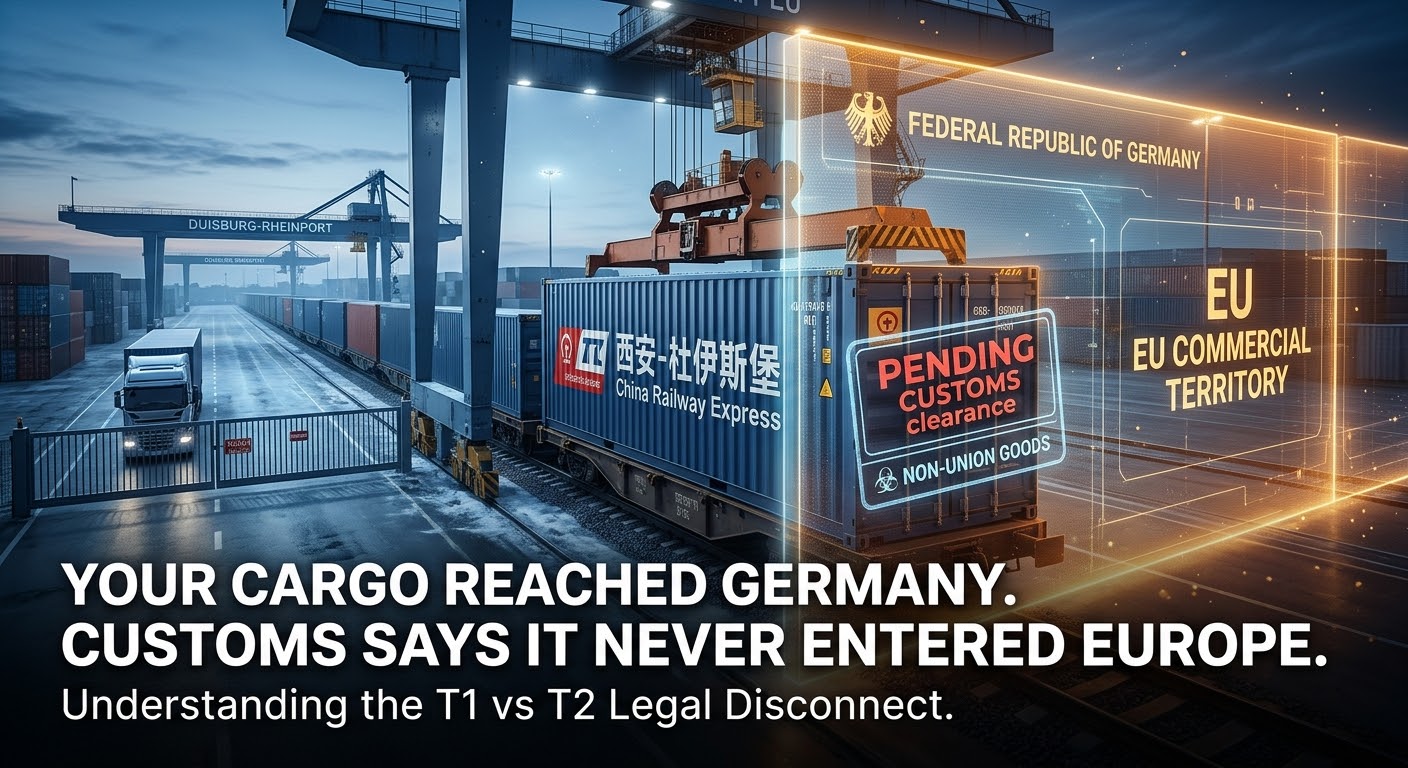
Why two transit documents — T1 and T2 — decide whether your container is really “in” Europe, and why Chinese exporters keep running into the same one.
A 40-foot container leaves Xi’an on a Tuesday. Twelve days later it rolls into the Duisburg rail terminal, right on schedule. The buyer in Lyon has a warehouse slot booked for Thursday morning.
The container sits in the yard for three days.
Not because trucks were scarce. Not because the warehouse was full. Because of a single document nobody had filed yet — and because, in the eyes of EU customs, that container had never actually entered Europe.
Physically
Duisburg rail terminal.
Unloaded, Day 0.
On the ground in Germany. Customs-supervised, not released.
Legally
Non-Union goods.
Not in EU territory.
Outside the EU’s commercial territory until released into free circulation.
This isn’t a rare failure. It’s the ordinary state of most China–Europe rail freight. And the reason comes down to a distinction almost nobody explains properly: the gap between where your cargo physically is, and what customs thinks it is.
Europe runs two parallel cargo worlds
EU customs law splits everything into two categories, and the split has nothing to do with geography.
Union goods have already been cleared, duty paid, released into free circulation. They move like domestic cargo — no transit paperwork, no supervision.
Non-Union goods have not. They remain under customs supervision even while they sit in a warehouse in Munich, even while they’re loaded on a German truck, even while a French driver is heading south with them.
That second category is where most Chinese exports live when they first arrive. A container can be physically in Germany — unloaded, inspected, on wheels — and legally still outside the EU’s commercial territory.
The closest everyday analogy is airport transit. You land in Frankfurt, walk through the terminal, buy an overpriced coffee. But you haven’t “entered” Germany in the immigration sense. You’re in an international transit zone. Customs treats goods exactly the same way.
T1 and T2 manage identity, not transport
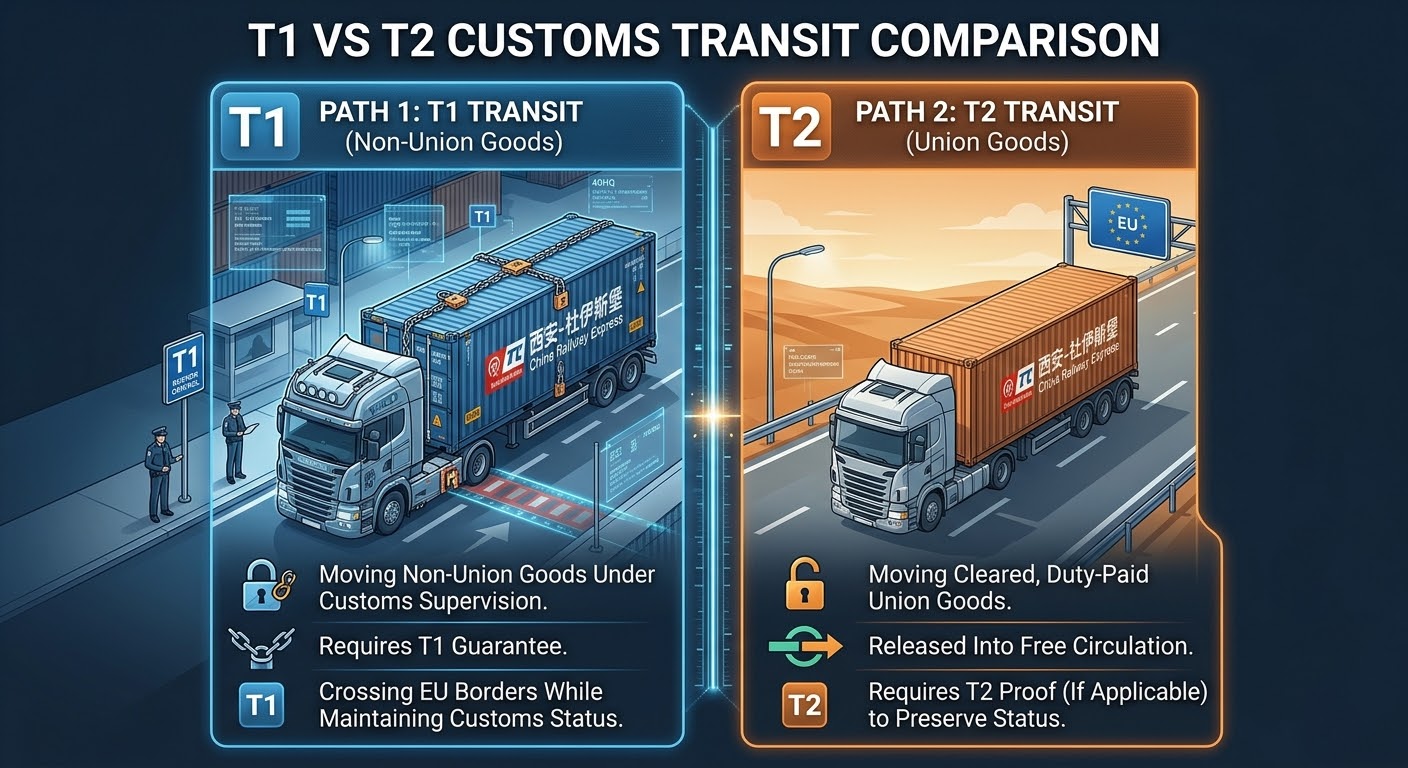
Here’s where most explanations go wrong. They call T1 and T2 “shipping documents.” They aren’t.
They’re identity management tools.
- T1 covers the movement of non-Union goods across EU customs territory. It says: this cargo hasn’t finished its import story yet — keep it under supervision while it moves.
- T2 covers Union goods that need to preserve their Union status during a specific cross-border movement.
Same paperwork family, opposite logic. T1 is about cargo that hasn’t been imported. T2 is about cargo that has, and needs to stay that way while it crosses a border.
That’s why two shipments can travel the same road, through the same countries, on the same day, and require completely different procedures. The road doesn’t decide. The cargo’s legal identity does.
Why Chinese exporters almost always meet T1
If your container arrives in Europe on a China–Europe train, it is almost certainly non-Union cargo. From the terminal, two paths open up.
Swipe to see both paths
Path one: clear it for import right at the arrival point — Duisburg, say. Pay duty, get released, done. From that moment it’s Union goods and moves freely.
Path two: don’t clear it yet. Maybe the final buyer is in Spain. Maybe you’re staging inventory in a European warehouse and clearing per order as customers pull stock. Either way, the cargo has to keep moving under supervision.
Path two is T1.
A typical sequence looks like this:
Rail terminal arrival → T1 transit declaration → truck pickup → road transport across one or more borders → clearance and delivery at destination
Read that again. The train arriving is not the end of the journey. It’s the midpoint of a customs process that hasn’t finished yet.
The document controls the clock
T1 is not paperwork. It’s the gate.
Until the T1 is lodged and accepted, the terminal will not release the container to a truck. No truck means no delivery. No delivery means the warehouse slot is gone, the production line waits, and demurrage starts ticking.
Here’s what that looks like in hours:
| Day | What happens |
|---|---|
| Day 0, 06:00 | Train arrives, terminal unloads |
| Day 0–1 | T1 declaration prepared and lodged |
| Day 2 | T1 accepted, container released to carrier |
| Day 3 | Truck loaded, departs Duisburg |
| Day 4–5 | Road transit to Lyon |
| Day 6 | Delivery and destination clearance |
Every downstream commitment hangs off one line in that table. Truck booking windows, cross-border transit schedules, warehouse receiving appointments, final clearance — all of it waits on the T1.
A slow T1 doesn’t delay one step. It delays the whole chain, and the cost compounds at every link: demurrage at the terminal, missed warehouse slots, idle production lines, penalty clauses.
This is the part that surprises people most. The bottleneck in European rail freight is rarely the train. It’s the handoff.
What’s actually hard
Anyone can book a train. Anyone can find a truck. The hard part is making the sequence work as a sequence — terminal operations, customs formalities, road capacity and destination requirements all landing on the same schedule.
A container that arrives on time but clears late is a late container. A container that clears fast but has no truck waiting is also a late container.
Real capability in European logistics isn’t transport capacity. It’s coordination under customs rules you don’t control.
Three things to decide before you book
First, choose your clearance model early. Clearing at the arrival point and moving under T1 are different operating models with different costs, timelines and warehouse implications. This decision shapes everything downstream. Making it after the train departs is too late.
Second, treat the T1 timeline as a hard constraint. Not an administrative detail to sort out later. If your delivery commitment to a customer is 20 days door-to-door, the T1 window is already inside that number.
Third, ask about the handoff, not just the transit time. “How long is the train?” is the easy question. “How long from arrival to my warehouse door, and who owns each step in between?” is the one that tells you whether your partner can actually deliver.
FAQ
Is T1 the same as import clearance?
No. T1 is a transit procedure. It keeps non-Union goods under customs supervision while they move between points. Import clearance is a separate step — the moment goods are released into free circulation. Confusing the two is the single most common source of planning errors.
Why do China–Europe rail shipments so often need T1?
Because most arrive as non-Union goods and don’t complete final clearance at the entry point. They either continue to another country or wait in a European warehouse for order-based clearance. Both scenarios require the cargo to stay under supervision.
Does holding a T1 mean my cargo won’t be inspected?
No. Transit status defines the customs regime, not the inspection outcome. Goods moving under T1 can still be examined at any point along the route.
Can I use T1 to move goods inside a single EU country?
T1 is designed for movement across customs territory, typically involving more than one customs office. Purely domestic movements generally follow different rules. If you’re unsure which applies, the answer depends on the cargo’s status, not the distance.
Does T2 apply to my shipment if I’m exporting from China?
Almost never. T2 is for goods that already hold Union status. If your cargo originated outside the EU and hasn’t been released into free circulation, T1 is the relevant procedure.
The takeaway
T1 and T2 look like jargon. Underneath, they ask a much simpler question: what is this cargo, legally, right now?
Physical movement and legal status are two different systems. Supply chains only work when both move together. The companies that get Europe right are the ones that treat the document as part of the route — not as an afterthought bolted on at the border.


Comments
Post a Comment