Transpacific Ocean Freight Strategy: Falling Spot Rates, Quote Spreads, and BCO vs. NVOCC vs. FAK/FIX Contracts
Transpacific container freight rates softened in early November 2026—with US East Coast rates falling faster than US West Coast rates—while spot quotes on the same trade lane still varied widely depending on contract structure, service tier, and transit time. For importers and supply chain managers, reading a freight quote accurately requires separating who holds the contract (BCO, NVOCC, NAC) from how the rate is priced and locked (FAK, FIX, Commodity, Index-linked, Spot).
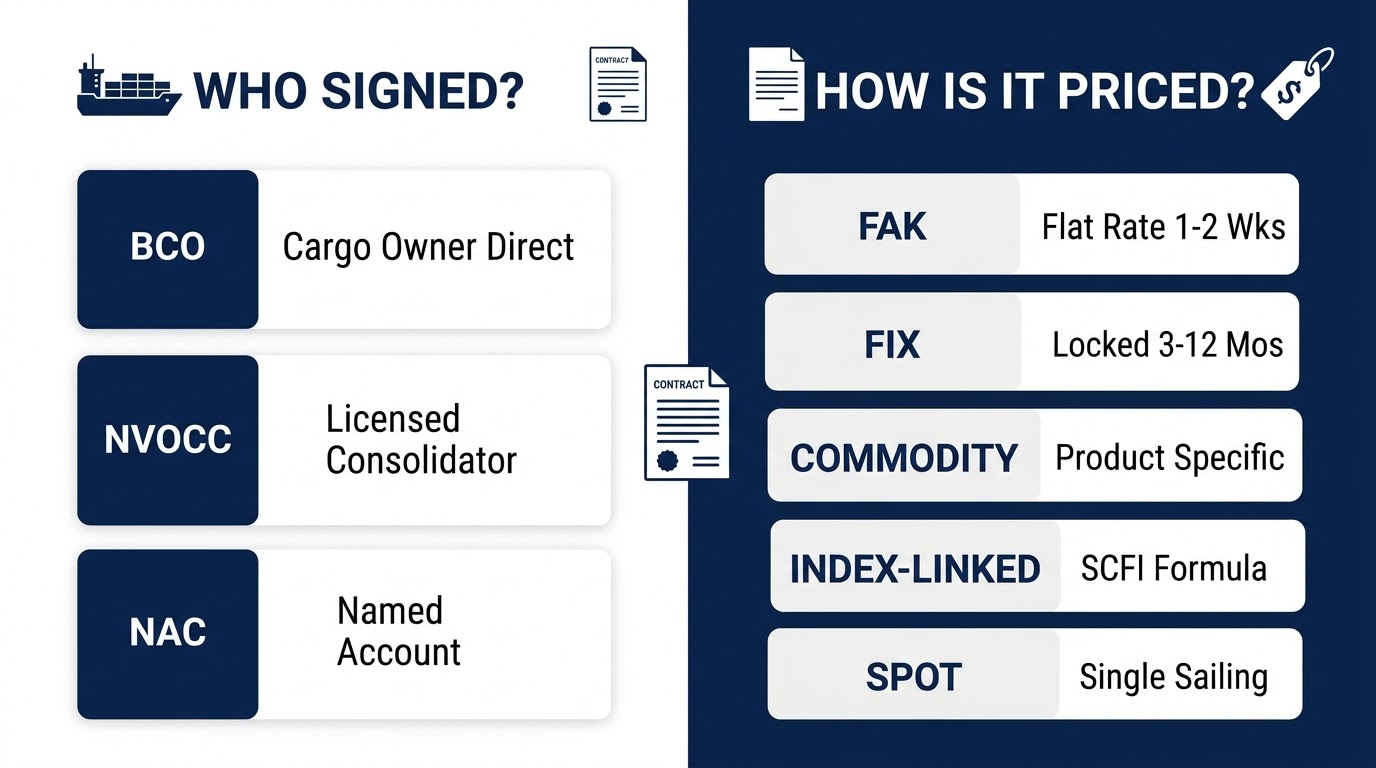
If you only look at a headline index average or a single quote line, you can misread both market timing and hidden cost exposure such as detention, demurrage, Minimum Quantity Commitment (MQC) penalties, or bill of lading discrepancies.
1. Market Context: Why Spot Rates and Quotes Diverge
In a softening market, index averages move gradually while real booking quotes split sharply across service tiers and contract types.
In the first week of November 2026, two major benchmarks showed downward movement on China–US lanes, with the East Coast dropping faster (as detailed in our November 2026 US container rate breakdown):
- Drewry WCI (Nov 5, 2026): Shanghai–Los Angeles stood at $7,539 / 40ft (unchanged week over week), while Shanghai–New York fell 3% to $9,303 / 40ft.
- Shanghai Shipping Exchange SCFI (Nov 6, 2026): Shanghai–US West Coast edged down 1.3% to $7,381 / 40ft, while Shanghai–US East Coast fell 3.4% to $9,857 / 40ft (dropping below $10,000 for the first time in 11 weeks).
- Demand backdrop: The National Retail Federation (NRF) projected November 2026 US container imports at 2.05 million TEU, down 9.3% from October's projected 2.26 million TEU, with December forecast near 2.03 million TEU.
At the same time, index averages do not equal actual booking prices. Direct China–US West Coast 40HQ quotes from our booking desk in mid-November 2026 spanned from $5,670 (slower/budget carrier options) up to $11,330 (express service), creating two distinct pricing clusters rather than a smooth curve around the index. Similarly, a low headline rate without checking free time or contract terms can result in heavy detention or demurrage charges weeks later.
2. Dimension 1: Who Signed the Contract? (BCO vs. NVOCC vs. NAC)
Ocean freight contracts answer two distinct questions: who signed with the carrier, and how the rate is priced and locked. Confusing these two dimensions is a primary source of billing, eligibility, and documentation mistakes.
| Contract Party | Who Signs With the Carrier | Bill of Lading & Shipper Field | MQC & Qualification | Typical Fit |
|---|---|---|---|---|
| BCO (Beneficial Cargo Owner) | Cargo owner directly with ocean carrier | Master B/L (MBL); contracting cargo owner appears as shipper | High annual volume / MQC; shortfall may trigger penalty | Large importers/brands with steady volume & dedicated teams |
| NVOCC (Non-Vessel-Operating Common Carrier) | Licensed/registered NVOCC with carrier (FMC rules apply in US trades) | House B/L (HBL); shipper often shows NVOCC unless structured otherwise | NVOCC manages carrier MQC; shipper can book smaller volumes | SMEs, multi-lane shippers, and flexible/consolidated cargo |
| NAC (Named Account Contract) | Contract issued via NVOCC bound to a specific named account | HBL restricted to the named account | Tied to NVOCC/account structure; strictly non-transferable to unnamed parties | Specific qualifying accounts with defined lane/volume terms |
- BCO: Provides direct carrier terms, stronger peak-season allocation protection, and often longer destination free time, but carries MQC obligations and potential rate inversion when spot rates fall below locked contract levels.
- NVOCC: Lowers the volume barrier for smaller shippers and provides operational/consolidation support, provided the NVOCC meets regulatory compliance (such as FMC licensing/registration and tariff rules for US trades) and terms are confirmed in writing.
- NAC: Applies strictly to a designated named party and cannot be lent to unrelated shippers without risking contract misuse and cargo holds.
3. Dimension 2: How Is the Rate Priced and Locked? (FAK, FIX, Commodity, Index-Linked, Spot)
Pricing mechanisms determine how long a rate holds, how it responds to market swings, and how vulnerable cargo is when vessel space tightens.
| Pricing Model | How Rate Is Set | Typical Validity / Lock | Key Advantage | Key Risk |
|---|---|---|---|---|
| FAK (Freight All Kinds) | Flat rate for lane & container type across general cargo | Short validity (often 1–2 weeks) | Simple baseline quoting for general cargo | Vulnerable to GRIs and lower priority when space tightens |
| FIX (Fixed Rate) | Rate locked for an agreed period | Often months (e.g., quarterly or longer) | Budget predictability & protection in rising markets | Above-market cost if spot rates drop; MQC shortfall risk |
| Commodity | Rate tied to a specific product category | Per contract terms | Better pricing for consistent single-category cargo | Commodity description mismatch can void contract rate |
| Index-Linked | Tied to a published index (e.g., SCFI) with agreed formula/discount | Periodic reset (e.g., monthly/quarterly) | Automatically tracks market direction | Less fixed upfront budget certainty |
| Spot | Single-sailing market rate | Per sailing / short-term | Maximum flexibility, no long-term lock-in | Price swings and roll/space risk in peak periods |
Note: A Forward Freight Agreement (FFA) is a financial derivative used for rate hedging—not a physical ocean transport contract for booking containers.
The FIX & MQC Trade-Off in a Softening Market
Locking a fixed rate protects against spikes, but when market rates drop below the contract rate, staying on the contract costs more per container while walking away can trigger an MQC penalty based on the shortfall and penalty coefficient. Importers should verify three items before signing:
- Exact MQC volume and whether MQC is enforced annually or by period.
- Penalty coefficient and calculation formula in writing before signing.
- Two-way commitments, including carrier space/service obligations and any grace or flexibility clauses.
4. Practical Decision Guide: Matching Market Timing, Contract Mix, and Execution
Rather than relying 100% on spot or locking 100% into a rigid contract, many importers use a blended approach—keeping core predictable volume under contract while leaving a buffer for spot opportunities.
- Near-term delivery vs. later quarters: Longer sea transit (such as US East Coast 26–35 days vs. West Coast 14–20 days) shifts booking cutoffs earlier, while softer demand forecasts into Q1 2027 create room to compare spot options—provided shelf dates and inventory buffers support waiting.
- US annual contract calendar: On US trades, Service Contracts (filed under FMC rules) follow an annual cycle centered around a May 1 effective date, meaning preparation typically starts in Q1 ahead of the mid-March negotiation window.
- Free time & inland costs: Destination free time (demurrage and detention clocks) and inland rail/trucking costs can easily outweigh small differences in ocean base rates—especially when terminal congestion or rail delays occur.
- Pre-booking documentation & execution checks: Confirm allowed release methods (Original B/L vs. Telex Release vs. Sea Waybill—especially under Letters of Credit), exact shipper/consignee naming rules, commodity wording, and factory cutoffs before cargo moves.
5. Quick Pre-Booking Checklist
Before confirming a booking or signing a rate sheet, verify these four checkpoints in writing:
- Contract type & named party eligibility: Confirm whether the booking runs under BCO, NVOCC, or NAC terms and whether your legal entity name matches.
- Pricing model & validity window: Confirm FAK, FIX, Commodity, Index-linked, or Spot terms, along with all-in vs. surcharge inclusions.
- MQC & penalty terms: Confirm minimum volume obligations and shortfall coefficients in writing.
- Destination free time & B/L release method: Confirm exact free days, when the clock starts, and permitted release terms before cargo sails.
Frequently Asked Questions (FAQ)
Can one shipment involve both an NVOCC contract and a FAK rate?
Yes. "Who signed" (e.g., NVOCC) and "how the rate is priced" (e.g., FAK) are separate dimensions of a booking, so a single shipment can move under an NVOCC structure priced on a FAK basis for a defined validity window.
Is a BCO contract always cheaper than using an NVOCC?
Not necessarily. A BCO contract can offer strong direct carrier terms at sufficient volume, but it requires meeting MQC commitments and can sit above spot rates when the market falls. For smaller or variable volumes, an NVOCC can be more practical once MQC risk and total landed costs are weighed.
Why does a cheap ocean rate sometimes end up costing more overall?
Base ocean rates do not capture destination demurrage and detention if free time is short or containers are delayed, nor do they capture inland trucking or rail costs, or documentation and Letter of Credit issues caused by mismatched shipper names or release terms.
When should importers prepare for US Trans-Pacific service contracts?
Because US Trans-Pacific service contracts typically take effect on May 1 with negotiations opening in mid-March, volume forecasting, lane analysis, and contract preparation are best completed during Q1.
Looking to evaluate contract vs. spot options for your China–North America lanes? Share your origin port, destination, monthly volume, and commodity details at STU Supply Chain to match your cargo pattern with the right booking structure.


Comments
Post a Comment