The 2027 EU "Digital Border" Trap: Why Your Shipment Could Be Seized at Customs Over a Missing QR Code
Imagine this: Your container of goods from China finally arrives at the Port of Rotterdam or Hamburg. The paperwork looks clean, the duties are calculated, and your buyers are waiting. Then, the European customs system scans the product’s digital identifier—and flashes red.
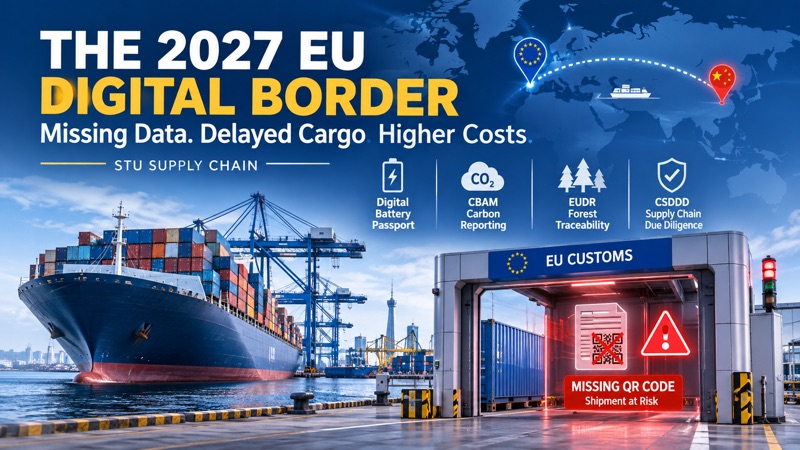 |
| The EU’s 2027 digital border transformation is changing how goods enter Europe. From Digital Battery Passports and CBAM carbon reporting to EUDR forest traceability and supply chain due diligence, Chinese exporters and European importers must prepare for stricter data and compliance requirements. Missing documentation could mean customs delays, higher costs, and increased supply chain risks. STU Supply Chain helps businesses navigate international logistics and cross-border trade challenges. |
Your cargo is frozen. Not because the product is defective, and not because of a tariff dispute, but because an upstream raw material supplier three tiers down the supply chain failed to log verified carbon footprint data.
While Brussels did scale back corporate sustainability reporting (CSRD and CSDDD) for smaller companies during its 2025–2026 "Omnibus Simplification" package, it did not soften the technical barriers required for physical goods to cross the European border.
Instead of asking companies to write pretty PR reports, the EU has built an automated, "penetrating" regulatory trap. Between late 2026 and 2029, four massive regulatory timelines collide. Here is how the EU is turning customs clearance into a granular data audit—and how importers can protect their cargo.
The "Four-Gear" Collision: 4 EU Regulations Overlapping in 2027
The real threat to sourcing from China isn't the strictness of a single law; it is the simultaneous interlocking of four distinct regulatory gears.
| Regulation | Hard Deadline / Window | Target Products & Industries | The "Hidden Trap" at the Border |
|---|---|---|---|
| EUDR (Deforestation) | Dec 30, 2026 (Large/Med) Jun 30, 2027 (Micro/Small) |
Wood, furniture, rubber, paper, coffee, cocoa, soy, cattle | Requires exact GPS geolocation coordinates proving zero deforestation after Dec 31, 2020. |
| Digital Battery Passport | Feb 18, 2027 | EV batteries, LMT (e-bike/scooter) batteries, industrial batteries (>2 kWh) | "No scan, no entry." Requires eIDAS verified digital seals before registration. |
| CBAM (Carbon Border Tax) | Sep 30, 2027 (First financial settlement for 2026) | Steel, aluminum, cement, fertilizers, hydrogen, electricity & downstream goods | Missing verified factory data triggers a punitive "worst-performer" default tax rate. |
| CSDDD (Due Diligence) | 2029 (Direct enforcement) 2027–2028 (Contract audits) |
Global supply chains feeding EU giants (>€1.5B turnover) | Tier-1 buyers will enforce strict ESG termination clauses in 2027 procurement contracts. |
Deep Dive: How "Penetrating Supervision" Works in Practice
1. The Digital Battery Passport: "One Code Fails, Cargo Halts" (Feb 18, 2027)
Starting February 18, 2027, batteries placed on the EU market must carry a unique QR code linked to a Digital Product Passport.
- The Pre-Clearance Bottleneck: Before a manufacturer can even register a passport, they must obtain "Verified Economic Operator" status using a qualified electronic seal under the eIDAS framework. Non-EU manufacturers without a European legal entity face a steep bureaucratic hurdle here.
- The Cross-Border Data Catch: The passport uses a four-tier access system (public, legitimate interest, and regulator-only). While EU regulators demand deep visibility into raw material formulas and dismantling metrics, China’s Data Security Law restricts exporting sensitive supply chain data. Navigating this legal tightrope requires pre-auditing what data can legally leave China.
2. CBAM Enters the "Pay-Up" Phase (Sept 30, 2027)
The Carbon Border Adjustment Mechanism (CBAM) transitioned from a reporting exercise to a real financial liability in 2026, with the first certificate surrender deadline hitting September 30, 2027.
- The Cost of Silence: If a Chinese steel or aluminum manufacturer cannot provide third-party verified, installation-level emissions data, the EU applies a punitive default value pegged to the worst-performing producers. In short: non-disclosure is priced at the highest possible tax penalty. (While carbon prices paid under China’s national carbon market can be deducted, claiming that credit requires airtight verification).
3. EUDR: No GPS Coordinates, No Customs Clearance (Dec 2026 – June 2027)
For importers of furniture, paper packaging, tires, and rubber goods, the EU Deforestation Regulation (EUDR) goes live on December 30, 2026 for medium and large enterprises (and June 30, 2027 for micro/small businesses). Importers must submit due diligence statements backed by satellite-verifiable geolocation coordinates of the exact plots of land where the raw timber or rubber was harvested.
4. The CSDDD "Contractual Contagion" (2027–2028)
While the Corporate Sustainability Due Diligence Directive (CSDDD) only directly regulates massive corporations (over €1.5 billion in turnover and 5,000+ employees) starting in 2029, the shockwaves hit in 2027. Major European retailers and automakers are rewriting procurement contracts to push audit liability down to Tier-1, Tier-2, and Tier-3 Chinese factories. If your factory fails a labor or environmental audit, your purchase order can be legally voided overnight.
The Importer’s Survival Guide: Why DDP Logistics is Your Best Shield
In 2027, sustainability is no longer a marketing narrative—it is a machine-readable customs parameter. Because a single product (like an e-bike or aluminum-cased battery pack) can trigger EUDR, CBAM, and Battery Passport checks simultaneously, traditional FOB or CIF shipping leaves European buyers completely exposed to customs demurrage, fines, and seized containers.
When European regulatory goalposts are shifting rapidly, shifting your shipping terms to DDP (Delivered Duty Paid) door-to-door logistics is the smartest risk-management move an importer can make.
How STU Supply Chain Protects Your European Imports
At STU Supply Chain Management, we specialize in navigating complex customs compliance between China and Europe across Ocean Freight, Rail Freight, TIR Cross-Border Trucking, and Air Freight.
- Pre-Shipment Compliance Screening: We verify HS codes, CBAM-covered material classifications, and packaging documentation before cargo leaves China, preventing costly surprises at European ports.
- End-to-End DDP Door-to-Door Execution: From factory pickup and export clearance in China to European customs brokerage, duty/tax settlement, and final-mile delivery, STU handles the entire regulatory chain under one transparent rate.
- Multi-Modal Flexibility: Whether you need fast TIR road transport to bypass port congestion, cost-effective China-Europe rail, or consolidated sea freight, we tailor the route to keep your inventory moving despite tightening border inspections.
Don't let a missing data point freeze your 2027 inventory at the European border.
Get a Custom China-to-Europe DDP Quote →

Comments
Post a Comment