Amazon Wins Every Aisle. Six Numbers Say Otherwise — US E-Commerce, H1 2026
A subscription store, a warranty business, a 33,000% toy chart, and an AI that checks out for you — the strange data hiding inside America's shopping carts.
THE SIX NUMBERS
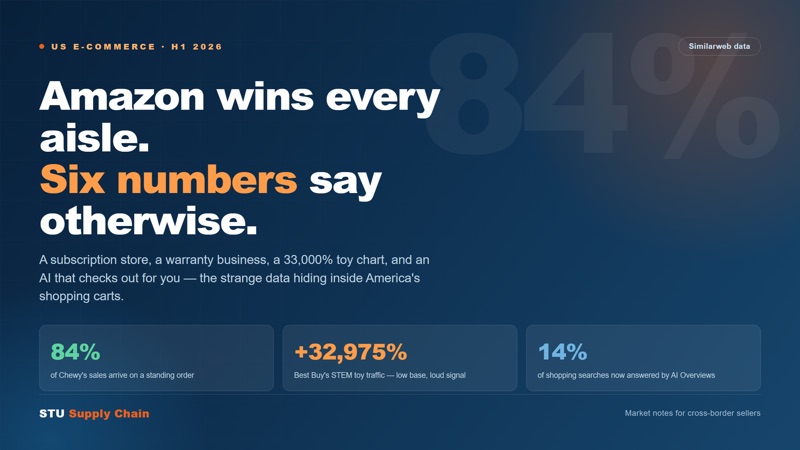
- 84% — the share of Chewy's net sales that arrive as standing Autoship orders, not one-off purchases.
- +338.5% — Newegg's growth in electronics warranty attach, recorded while its overall sales fell nearly 12%.
- +32,975% — Best Buy's growth in STEM toy traffic. Small base, loud signal; Walmart and Target grew 674% and 172.1% in the same niche.
- 102.7% vs 19.8% — swimwear traffic growth at Quince versus Walmart. Assortment beat scale by five to one.
- 14% — shopping-related searches where Google AI Overviews appear, up from 2.1% four months earlier.
- Q3 2026 — when Mattel, Hasbro and Gap scheduled their main price increases, quietly moving tariffs down the calendar.
America's online shopping has a settled headline: Amazon wins. It wins electronics, toys, pets, clothes, sofas and footballs — six for six on traffic. Sellers read that headline and conclude there is one market and one doorway into it.
The first-half 2026 data says something more interesting. The same dataset that crowns Amazon also contains a pet retailer where most revenue arrives on a standing order, an electronics store that grew a service business while its product sales shrank, a toy category whose fastest-moving chart rose five figures, and a search layer that is quietly starting to do the shopping itself. None of these stories are about beating Amazon. All of them are about not needing to.
01 · The scoreboard — and the gap that matters
First, the part everyone agrees on. Across six major categories, Amazon holds the largest share of website visits in every single one, per Similarweb Retail Intelligence:
| CATEGORY | AMAZON | NO. 2 RETAILER | GAP TO NO. 2 |
|---|---|---|---|
| Electronics | 76.4% | Best Buy — 6.6% | 69.8 pts |
| Toys & games | 72.2% | Walmart — 11.0% | 61.2 pts |
| Sports & outdoors | 64.3% | Walmart — 5.6% | 58.7 pts |
| Home & kitchen | 58.0% | Wayfair — 10.8% | 47.2 pts |
| Pet supplies | 55.3% | Chewy — 26.1% | 29.2 pts |
| Apparel | 41.9% | Gap — 16.4% | 25.5 pts |
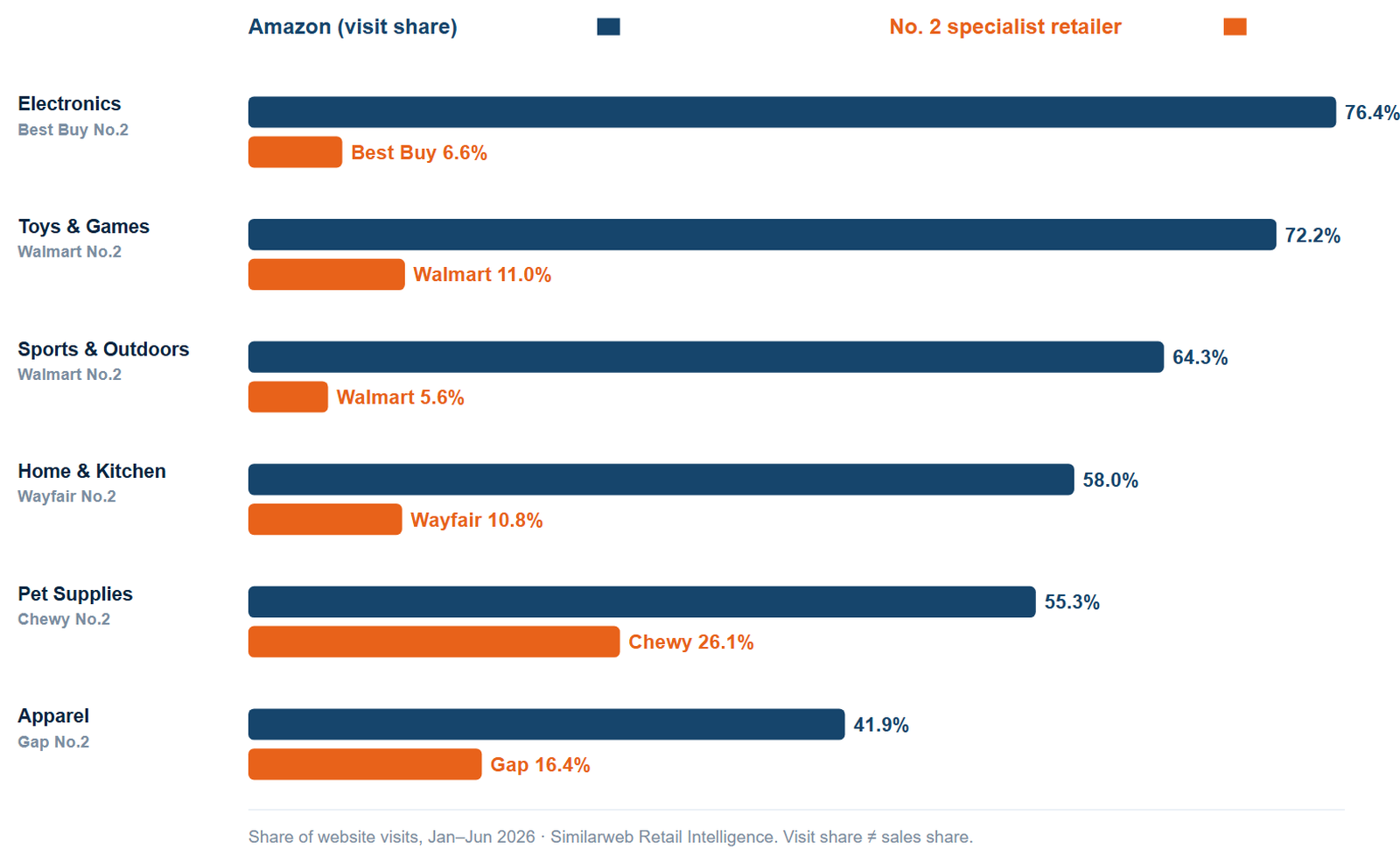
Read the last column, not the second one. In electronics, the runner-up is barely on the map. In pets and apparel, the number two holds a quarter and a sixth of all traffic respectively — and, as the next section shows, holds it with something Amazon's structure finds hard to copy.
02 · 84% — the pet store that is really a subscription
Here is the strangest retail fact of the year: 84% of Chewy's net sales now flow through Autoship, its auto-delivery program. Four out of five dollars at America's second-largest pet retailer arrive not because a customer visited and decided, but because a standing order executed — dog food, litter, medication, refilled on schedule like a utility bill.
Chewy has been engineering itself toward that number for years, and is now buying its way further in with a planned acquisition of the veterinary network Modern Animal — pulling pet healthcare itself into the subscription. Tractor Supply, a farm-and-ranch chain with under 2% of pet category traffic, is telling the same story in miniature: management credits triple-digit growth in its online pet subscription business and an expanding membership program.
03 · +338.5% — the store learning to stop selling hardware
Newegg's first half was bad and fascinating in equal measure. Overall sales fell by nearly 12%. Its electronics warranty attach rate grew 338.5%.
Sit with that combination. A retailer whose core product is under demand pressure did not respond with deeper discounts. It sold more protection plans per box — revenue that arrives with no freight, no warehousing and no obsolescence, attached to transactions that were going to happen anyway. Best Buy's own traffic numbers point the same way: its fastest-growing niches were accessories and consumables (+74.8%), smart wearables (+57.3%) and phones (+32.8%) — the cheap, repeatable perimeter around expensive, slow-moving screens.
When the thing in the box stops being where the money is, the box's surroundings take over. For hardware sellers, that perimeter — accessories, compatibility, warranty, after-sales clarity — is looking less like a side business and more like the margin itself.
04 · +32,975% — a number you should distrust, and why it still matters
The single most absurd figure in the dataset: Best Buy's STEM toy traffic grew 32,975% in six months, pushed by magnetic tiles, LEGO Technic and Ideas sets, and MEGA BLOKS. Walmart's equivalent grew 674% and Target's 172.1%.
Three zeros of that percentage are arithmetic on a tiny base, and anyone quoting it as market size is selling something. But strip the exclamation marks and a real shift remains. Pokémon cards — a 1990s collectible — now account for roughly 50–55% of toy brand mix at Target, Best Buy and Macy's. Construction toys, trading cards and adult-oriented collectibles are growing outside the holiday-gift calendar that traditionally defined the toy business. Toys stopped being a seasonal gift category and became, in part, a hobby and investing category with its own collect-them-all loop.
05 · Five to one — the swimwear race that scale lost
Same product, same season, same country. In the first half of 2026, swimwear traffic at Quince grew 102.7%. At Walmart, the largest retailer in America, it grew 19.8%. A digital-first brand with a fraction of the traffic outgrew the giant five-to-one in the same niche.
The same half produced its twin: Gap grew comparable sales 10% while sister brand Old Navy managed 1% — same group, same buying calendar, different assortment decisions. Scale decides who can afford a mistake. Assortment decides who makes one.
For seasonal categories — swim, sport, holiday — the lesson is uncomfortable but cheap to act on: the winner is rarely the biggest catalog. It is the sharpest answer to one specific moment, sized correctly and timed early, with returns and size-fit economics priced in before the season starts.
06 · The front door moved: AI now shops before people do
The quietest disruption in the dataset is also the one with the longest half-life.
- Amazon replaced Rufus with Alexa for Shopping on 13 May 2026 — an assistant that can complete the purchase itself when a product hits your target price. A machine, transacting, without a human comparing tabs.
- Best Buy went the other way, feeding its catalog into ChatGPT and Google AI Mode — meeting customers inside assistants it does not own.
- Google AI Overviews appeared in 14% of shopping-related searches by March 2026, up from 2.1% in November 2025. Nearly one in seven shopping queries now gets its first answer synthesized, not linked.
Stack those and a new sequence emerges: a growing share of shopping decisions are being shortlisted by a machine before a human ever visits a store. That machine does not respond to beautiful banners or ad budgets. It reads structured facts — what the product is, what it fits, what it costs, what the return policy says.
Bonus number: Q3 — the price increases hiding in the calendar
Tariff costs did not vanish in the first half; they were rescheduled. Mattel, Hasbro and Gap all placed their most significant price increases in the third quarter — a tell that retailers are absorbing tariff costs while watching whether demand holds. For anyone importing into the US, the operative question is no longer "what is the tariff rate" but "who eats it": supplier margin, seller price, or shelf price. Low-margin, undifferentiated SKUs are where that answer gets ugly, which is why landed-cost scenarios — not hopeful pricing — should decide what ships in Q4.
What to watch in the second half
| SIGNAL | WHAT TO TRACK | WHY IT MATTERS |
|---|---|---|
| Tariff pass-through | Q3 price moves in toys, apparel and imports; demand response | Determines which categories can hold margin in Q4 |
| AI shopping entry points | AI Overviews coverage beyond 14%; adoption of auto-purchasing assistants | Discovery is shifting from links to answers; product data decides visibility |
| Niche depth | STEM toys, collectibles, storage & garment care, pet consumables | Repeat-purchase niches outgrow broad-catalog plays |
| Event calendars | Back-to-school, holidays, sport events after the World Cup window closed | Event demand is a spike, not a trend — plan inventory to the calendar |
The one-sentence version
Amazon won the traffic trophy in all six categories — and simultaneously proved, through Chewy's subscriptions, Newegg's warranties, Quince's swimwear and Best Buy's toy aisle, that the profitable game in 2026 is not visiting every aisle. It is owning one, completely, with a mechanism that brings the customer back without being asked.
Frequently asked questions
Which US e-commerce categories does Amazon dominate most?
By share of website visits in the first half of 2026, Amazon's strongest categories were electronics at 76.4%, toys and games at 72.2%, and sports and outdoors at 64.3%, according to Similarweb Retail Intelligence. Home and kitchen stood at 58.0% and pet supplies at 55.3%.
Where is Amazon most vulnerable in the US market?
Apparel and pet supplies show the widest openings. Amazon's apparel visit share was 41.9% with Gap second at 16.4%, and in pet supplies Chewy held 26.1% against Amazon's 55.3% — the closest race of any major category, built on subscriptions rather than price.
How much of Chewy's revenue comes from subscriptions?
Chewy's Autoship auto-delivery program accounted for 84% of its net sales, and the company has been expanding into veterinary services. The model converts one-time purchases into scheduled repeat consumption, which is why Chewy can hold a quarter of category traffic against Amazon.
Did STEM toy traffic at Best Buy really grow 32,975%?
The percentage is real but the base was tiny, so the figure reflects a niche moving mainstream rather than a vast market. Walmart's STEM toy visits grew 674% and Target's 172.1% in the same period, driven by magnetic tiles, LEGO Technic and Ideas sets, and MEGA BLOKS construction toys.
How is AI shopping changing how products are discovered?
Amazon replaced its Rufus assistant with Alexa for Shopping in May 2026, which can complete a purchase automatically when a product reaches a target price. Best Buy opened its catalog to ChatGPT and Google AI Mode. Google AI Overviews appeared in 14% of shopping-related searches by March 2026, up from 2.1% in November 2025 — meaning products are increasingly evaluated by AI systems before a shopper reaches any website.
Did the 2026 World Cup affect US sports retail?
Yes. The tournament ran from 11 June to 19 July 2026 across the US, Canada and Mexico, and fan merchandise visits grew 121.8% at Dick's Sporting Goods, 25.3% at Walmart and 18.1% at Amazon during the first half. Event-driven demand is a window, not a trend — it fades once the tournament ends.
How are tariffs affecting US retail prices in 2026?
Several major retailers and brands, including Mattel, Hasbro and Gap, scheduled their most significant price increases for the third quarter of 2026 rather than the first half, absorbing tariff costs while watching demand. The open question for importers is who ultimately pays: the supplier's margin, the seller's price, or the consumer.
What should smaller sellers take from this data?
Three things: pick a niche with a repeat-purchase logic instead of chasing every category; keep complete, structured product data so both shoppers and AI systems can understand what you sell; and plan landed costs under multiple tariff and pricing scenarios before committing to low-margin SKUs.
STU Supply Chain — market notes for cross-border sellers. Freight forwarder and NVOCC (MOC-NV09192, FMC 030310), Shenzhen.
Data: Similarweb Retail Intelligence, share of website visits, January–June 2026; company disclosures cited by that report. Visit share is not sales share; some sub-category growth rates reflect low bases. Retailer and brand names belong to their respective owners and appear for identification only.


Comments
Post a Comment