Air Cargo This Week: A Tale of Two Markets
If you’ve been watching air freight rates lately, you’ve probably noticed something odd. The market isn’t moving in one direction. It’s splitting.
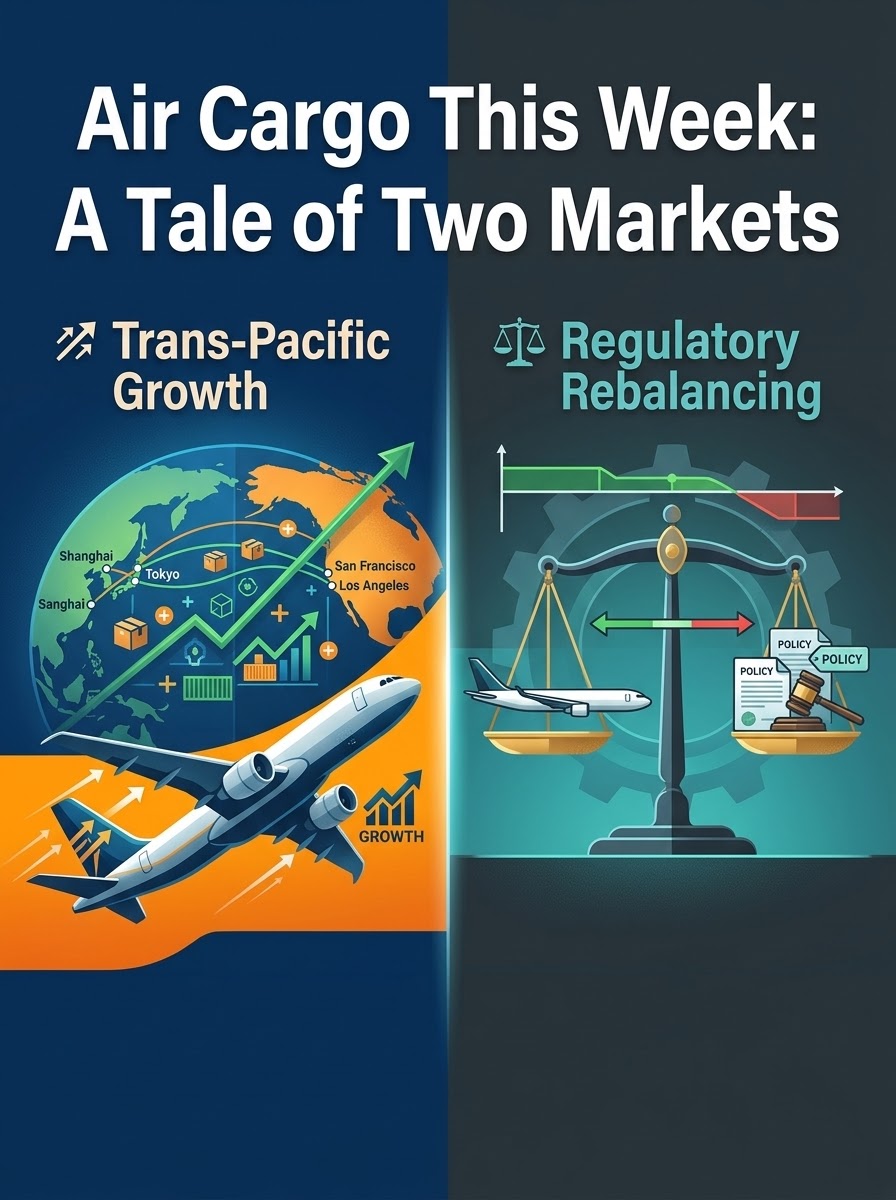 |
| Air Cargo Market: A Tale of Two Markets – Trans-Pacific Growth vs. Regulatory Rebalancing. |
On some lanes, nothing much is happening. On others, cargo is quietly creeping higher — not because demand is exploding, but because capacity is getting eaten away.
Here’s what’s really going on in global air cargo right now.
The big picture: calm on the surface, pressure underneath
This week, the air cargo market is running on two different tracks.
The U.S. lane is flat. Most Black Friday pre-stocking has already passed, and there’s no big wave of new cargo pulling rates higher. Only urgent shipments are seeing small premiums.
The Europe lane is slightly firmer. Christmas replenishment is coming through steadily, but it’s not a sudden surge. Belly-hold space is gradually being absorbed, so rates are testing higher at a slow, cautious pace.
Next week looks similar: U.S. rates stay range-bound, Europe stays mildly firm, and the real headaches are hiding in Southeast Asia, South America, the Middle East, and Africa.
North America: quiet, but not cheap
The trans-Pacific air market is holding steady. There’s no major volume spike, and most new bookings are scattered rush orders or small replenishment shipments.
That doesn’t mean space is easy. AI-related electronics, servers, and high-value components continue to absorb capacity on premium lanes. So while base rates aren’t jumping, urgent cargo can still face tight space and higher add-ons.
For shippers to the U.S., the message is simple: don’t expect a big drop, but don’t panic either. Plan around firm deadlines, not hopeful rate cuts.
Europe: Christmas cargo is moving, but slowly
Europe is the more active lane right now. Holiday replenishment is releasing in an orderly way, and carriers are testing slightly higher rates.
But this isn’t a sharp spike. Demand is steady rather than explosive, and capacity is tightening gradually as belly space fills up.
If you’re shipping consumer goods, seasonal products, or e-commerce inventory into Europe, it makes sense to book ahead. The risk here isn’t necessarily a sudden price explosion — it’s space disappearing right before you need it.
Southeast Asia: Bangkok is the bottleneck
Southeast Asia looks calm on paper, but one airport is causing outsized problems: Bangkok Suvarnabhumi (BKK).
BKK has been dealing with heavy cargo congestion, with goods queuing for warehouse entry and sorting delays slowing both inbound and outbound flows. Transiting cargo is especially vulnerable.
If your shipment is routing through Bangkok, treat it as high risk. Consider diverting to Singapore (SIN) or Kuala Lumpur (KUL) instead. Bangkok can still work for non-urgent cargo, but it’s no longer a reliable transit point for time-sensitive shipments.
South America: transit congestion is real
South America remains difficult because direct flights are limited. Most cargo moves through hubs, and several key airports are currently overloaded.
Goods are queuing for warehouse intake, transit links are sluggish, and rates are rising because space is scarce rather than because demand is booming.
For urgent South American shipments, don’t assume a single routing will hold. You’ll want backup options, extra buffer time, and a forwarder who can pivot quickly when a hub gets blocked.
Middle East: geopolitics keeps the market unstable
The Middle East continues to be one of the most unpredictable regions in air cargo. Flight frequencies have dropped, carriers are canceling or rerouting more often, and capacity swings can happen with little warning.
Project cargo and retail replenishment are still moving, and some shipments are routing via Europe. But as European capacity tightens slightly, those alternatives aren’t as comfortable as they were a few weeks ago.
Africa: fragile connections, high delay risk
Africa is arguably the most fragile lane right now. Direct capacity is scarce, and most cargo depends on Europe or the Middle East for connections.
With several core airports also experiencing congestion and limited ground handling capacity, transit cargo can easily get stuck. Rates are drifting higher, but the bigger issue is unpredictable transit time.
If you’re shipping into Africa, build in extra days. What looks like a three-day transit can easily stretch longer when a connection misses a handoff.
What shippers should do this week
● U.S. shipments: Expect flat rates with small premiums for urgent cargo.
● Europe shipments: Book early if your cargo is time-sensitive.
● Southeast Asia: Avoid Bangkok for urgent transits; consider Singapore or Kuala Lumpur.
● South America: Prepare alternate routings and allow extra buffer time.
● Middle East / Africa: Expect volatility and prioritize flexible routing over the cheapest quote.
The takeaway
This week’s air cargo market isn’t telling one story. It’s telling several.
The U.S. lane is calm. Europe is slowly firming. Bangkok is clogged. South America and Africa are bottlenecked. The Middle East remains unpredictable.
In a market like this, the cheapest rate isn’t always the best rate. The best rate is the one that actually gets your cargo moving when you need it.
If you’re planning air freight from China this week, send over your origin, destination, cargo weight, and target delivery date. We’ll help you compare realistic options before a bottleneck turns into a delay.


Comments
Post a Comment