The Cheapest Freight Quote Is the Most Expensive One
Here's a story almost every US importer has lived at least once.
You compare three freight quotes for a container from China. Forwarder A comes in $1,200 cheaper than everyone else. You take the deal. And then the container gets rolled off the sailing, sits an extra two weeks at the origin port, your customer cancels the order, and the "savings" quietly evaporate into detention fees, rescheduling costs and a lost sale.
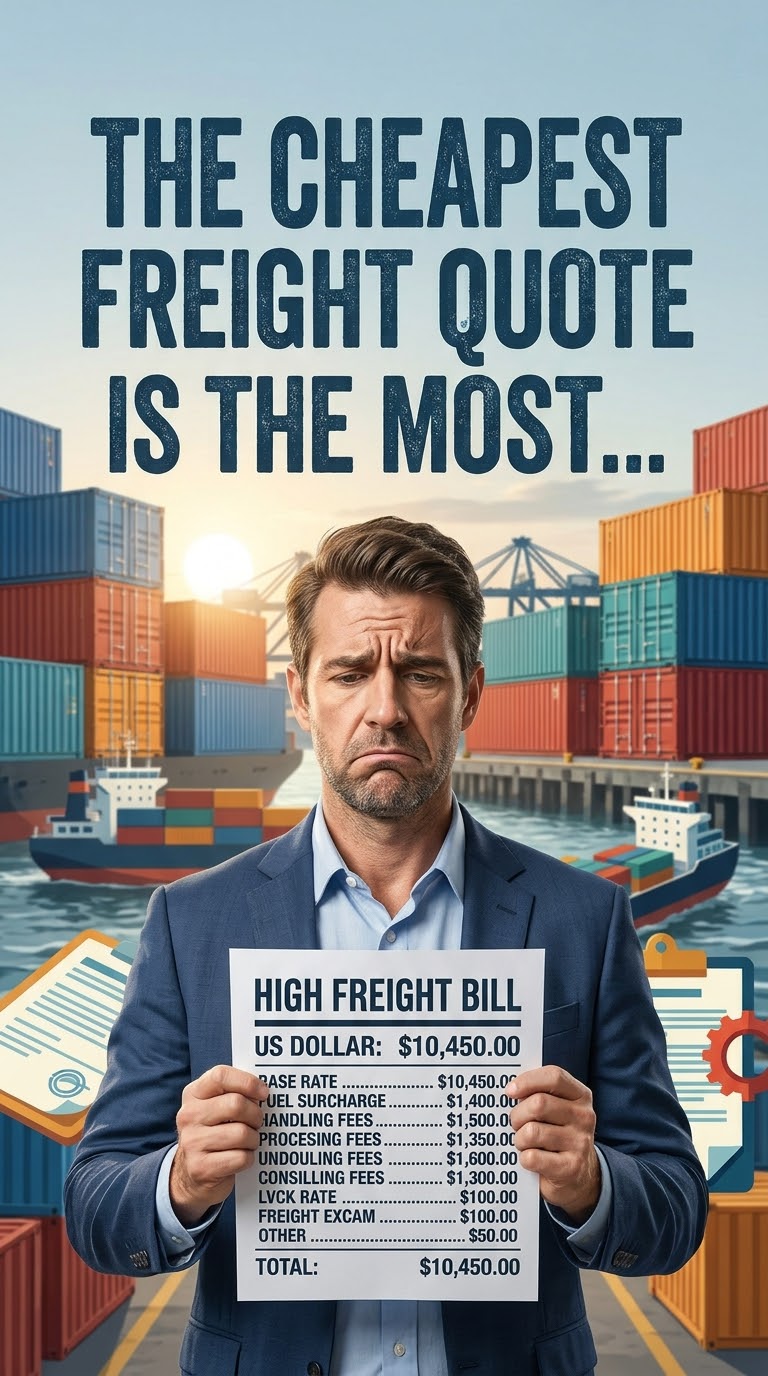 |
| The cheapest freight quote is often the most expensive"—shippers who fall for unrealistically low initial rates frequently end up facing unexpected hidden fees, delays, and skyrocketing total costs at the destination. |
Cheap quotes don't just happen. Somebody is paying for the difference — and more often than not, it's you.
Here's the uncomfortable truth about sea freight from China to USA: the forwarders who can actually deliver your cargo on time are rarely the ones quoting the lowest number. It's not a coincidence, and it's not greed. It's math. Here's why — and what a smart importer should look at instead of the bottom line.
1. Real service costs real money
A freight forwarder that moves serious volume doesn't run on a laptop and a phone plan. Behind every reliable shipment is a service team, a booking system, warehouse operations, chassis and drayage partners, and compliance staff — and every single link has to work without drama. That infrastructure is expensive to build and expensive to keep running.
If a forwarder cuts price, something in that chain gets cut too. Maybe it's the warehouse staffing on your pickup day. Maybe it's the person who would have caught your document mistake before customs did. You don't see the cut at signing. You see it when the shipment goes sideways.
2. Guaranteed space is a scarce resource
Here's something most importers never think about: when peak season hits, cheap space is the first space to get rolled.
Carriers allocate their best berths, the stable equipment, and the reliable schedules to the forwarders who pay premium rates and move volume year-round. A forwarder surviving on lowball pricing doesn't have the buying power to protect your container when the sailing fills up. You get the leftover slot — or no slot at all.
Guaranteed space, priority loading, and stable schedules are scarce resources. They cost money upstream. The forwarder who "saves" you a few hundred dollars today is exactly the one who can't protect you in October.
3. Compliance teams are expensive — until you get caught
Experienced importers know that a customs problem can cost more than the entire shipment's freight. Missing documentation, a wrong HS code, an import rule that changed last quarter — these are the errors that turn a two-week delivery into a six-week headache.
Top forwarders spend real money hiring people who understand US customs, ISF filing, Section 301 duties, and the compliance rules on both sides of the ocean. They build overseas networks so there's someone watching your cargo at every handoff. That's why their shipments get inspected less, get held less, and get lost less.
That level of safety is not free. But it's a lot cheaper than the alternative.
4. Market leaders don't win customers with lowballs
Think about how a forwarder that actually has a reputation protects it. They can't afford to undercut everyone and still deliver — so they don't compete on price at all. They compete on the things that keep clients: on-time performance, communication, and the ability to get cargo out when the market is a mess.
When a company reaches that level, cutting prices would be brand suicide. You attract the customers who want reliability, you keep them with results, and your advantage becomes value and trust — not the lowest number on a spreadsheet.
5. The cheapest quote is hiding a bill
One price for the freight. Then the port charges arrive. Then the demurrage. Then the "fuel adjustment." Then the roll fee. Every importer knows this pattern: the low quote got you in the door, and the fees turned it into the expensive option.
There's an old comparison that still holds: a budget phone lasts about two years, a premium phone lasts five. When you add it up, the "cheap" choice cost just as much — and caused more pain along the way. Freight works the same way. Over a single shipment, the difference between a good forwarder and a cheap one can look small. Over a year of peak-season chaos, it's the difference between staying in stock and explaining to your biggest customer why their order is late.
What to do instead of chasing the lowest quote
- Ask what's actually included. Port charges, chassis, customs clearance, duties, final-mile delivery — a quote without these isn't a quote, it's a teaser.
- Ask what happens if the vessel rolls. A real forwarder has a schedule commitment and a plan B. A cheap one has a shrug.
- Ask about the service, not just the price. Fast-boat services with priority unloading exist for a reason: cargo that arrives on time sells; cargo stuck at anchorage doesn't.
- In peak season, buy speed and stability. The cheapest rate in September is the most expensive mistake you can make in November.
Freight forwarding comes down to one question in the end: not who's cheapest, but who gets your cargo safely to your warehouse when the market is tight. Quality service requires serious investment — which is exactly why its price can't be low.
Want sea freight from China to USA that doesn't gamble on peak season?
STU Supply Chain's Matson Express delivers from major China ports to the US West Coast in roughly 11–15 days port-to-port, with priority offloading at Matson's dedicated Long Beach pier and full DDP door-to-door service in 15–22 days. One transparent quote, schedule commitment included.
WhatsApp +86 136 6226 6273 or email sales@stusupplychain.com — itemized quote within 24 hours.


Comments
Post a Comment