LA's "Land-Side Storm"
Your container is on the water, heading to Los Angeles, so you relax. Big mistake. The ocean isn't the problem this season — the shore is.
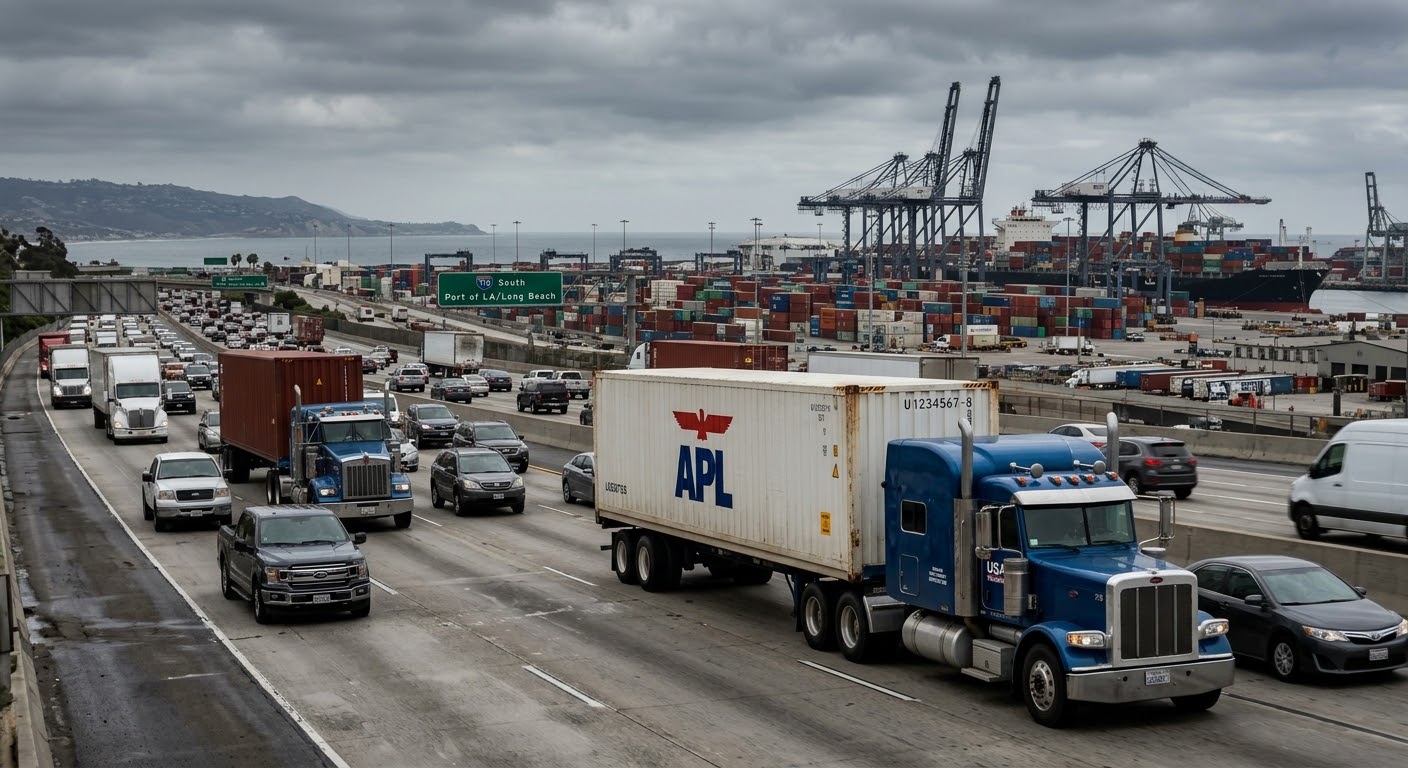 |
| As land-side challenges intensify at major U.S. gateways, trucking delays, chassis shortages, and congested highway corridors have become critical roadblocks in moving freight out of the ports. |
Welcome to the "land-side storm." Three separate pressure waves are stacking up at the largest gateway for US imports, and together they're creating the most complicated land-side logistics test the port has faced in years.
The numbers you need to know
As of October 26, 35,700 import containers were waiting for rail loading across the ports of Los Angeles and Long Beach. Of those, more than 10,500 had already been sitting at the docks for at least nine days.
Los Angeles is hit worse than Long Beach. Of the 19,626 containers waiting on rail at LA, 8,133 — about 41.4% — had been there over nine days. Long Beach's long-dwell share was 15.1%. In September, average rail dwell across both ports climbed to 7.19 days, up from 6.75 days in August.
Why the backlog happened
The cause is brutally simple: record volume met a rail system that couldn't absorb it. September produced the highest monthly throughput in the ports' history — roughly 1.04 million TEUs at Los Angeles and 997,000 at Long Beach, about 2.04 million combined. Ships kept getting unloaded. But railcars were scarce and the east-west flow of equipment is imbalanced, so inland distribution couldn't keep pace.
Port of Los Angeles executive director Gene Seroka says westbound rail resources have increased "six, eight, even tenfold" over the past three weeks, and the situation is "correcting quickly." Encouraging — but a backlog that big doesn't vanish overnight.
Who gets hurt most? Cargo destined for the Midwest and South, shipments moving via IPI or inland intermodal, and anything with a tight FBA or retail delivery window. Some retailers are already worried that holiday inventory may miss the Black Friday shelf.
Add a strike threat on top
The rail problem isn't the only variable. ILWU Local 26 — about 250 port security and gate-control workers, roughly 2% of the ILWU workforce at the twin ports — has been negotiating for over a year. Their contract expired in July 2025 and has been running under extension. The union says it could strike if no deal is reached, potentially from November 1. Talks continue under federal mediation, and no strike has been confirmed.
250 people sounds small until you understand their job: gate security, personnel and vehicle control, port-area patrols. Under US maritime safety rules, terminals cannot legally operate without them — and union solidarity means other ILWU members typically won't cross a picket line. PMA warns the affected terminals handle about 85% of Long Beach's and 33% of Los Angeles' cargo volume. Ship operations, yard work and gate traffic could all grind to a halt.
And a bridge that's closing for 16 months
The third wave is the Vincent Thomas Bridge. Caltrans has confirmed it will close fully from 12:01 a.m. on November 7 for a $753 million deck replacement, with reopening expected around March 2028.
The port itself says all terminals stay open and cargo throughput and rail operations are unaffected. The problem is local trucking: about 8% of port drayage traffic uses the bridge. Traffic will be rerouted to I-710, I-110, State Route 103 and Harry Bridges Boulevard. Caltrans has upgraded those routes, but longer trips are unavoidable — which means lower drayage efficiency, tighter warehouse appointment windows, and more detention risk for importers who rely on local pickup and container returns.
Your priority checklist right now
- Rail-bound cargo (IPI / inland destinations): This is the most strained link. Confirm railcar allocation with your carrier immediately — Union Pacific and BNSF are reportedly enforcing strict quota systems. For time-sensitive holiday inventory, line up a backup plan.
- Cargo arriving around November 1: Watch the labor talks like a hawk. If a strike hits, terminal gates may close and pickup plans need to be rebuilt. Pre-arrange alternative pickup windows with your drayage company and confirm terminal operating status daily.
- Local truck pickup after November 7: Confirm reroute plans and the extra transit time with your trucker. An 8% diversion isn't fatal — but combined with a dense terminal yard, pickup efficiency will drop. Build buffer into warehouse appointments.
The bottom line
LA's ocean side looks calm. That calm is hiding three simultaneous strains: a rail backlog measured in tens of thousands of boxes, a strike clock that could close gates within days, and a bridge closure that will quietly slow every truck for the next 16 months.
If you have cargo in the pipeline — or a Black Friday promise to keep — the time to move is now, not when the headlines get louder.
Your inventory shouldn't be held hostage by port chaos.
The fastest, most stable option for sea freight from China to USA today is STU Supply Chain's Matson Express: roughly 11–15 days port-to-port, priority offloading at Matson's dedicated Long Beach pier, and DDP door-to-door in 15–22 days — with a schedule commitment and 24-hour visibility so you're never guessing where your cargo is.
WhatsApp +86 136 6226 6273 or email sales@stusupplychain.com — itemized quote within 24 hours.


Comments
Post a Comment