It Was Never the Freight Rate: Three Customs Rules That Now Decide If Your Container Clears — or Sits
Two containers. Twenty-four hours. Eleven days.
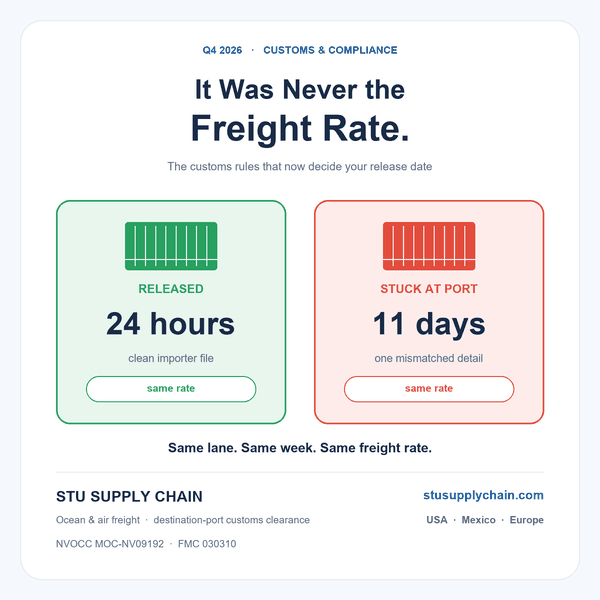
Ask ten importers what the biggest headache in their business is, and nine of them will answer the same way: the freight rate.
They are all answering the wrong question.
Here is how you find out the hard way. Two containers leave the same factory in Shenzhen in the same week, on the same vessel, booked on the same rate. One is released by customs within twenty-four hours of arrival. The other sits for eleven days.
Eleven days is not a delay. Eleven days is demurrage and storage bills stacking up several hundred dollars a day, a retail window quietly closing, a warehouse team paid to wait, and a customer who has now decided that you — not the port, not the carrier, not the market — are the reason their shelves are empty.
Same route. Same rate. Same week. So what was different?
A document file. And not the document anyone had been watching.
This is the part of importing that no rate sheet will ever show you, and it is exactly where most importers are least prepared.
The thesis of this article in one line:
What keeps an importer awake at night is never the freight rate — it is control at the customs end.
>
As an importer, price is only half your job. The other half is tracking what is changing in import customs policy. If you import into the United States, Mexico or Europe, the rules below are directly about you.
And here is the uncomfortable timing: all three of those markets are tightening at once.
Three markets, three traps, one direction
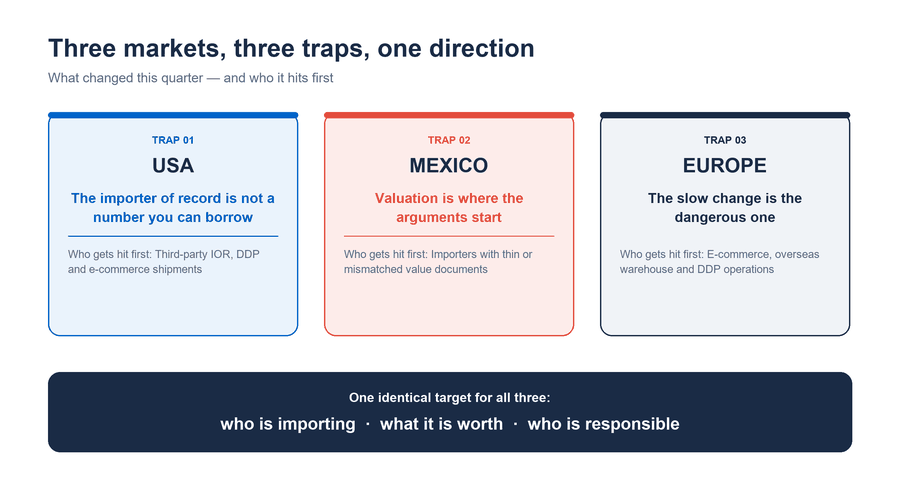 |
| Three markets, three traps — one identical target: who is importing, what it is worth, who is responsible. |
Market | What is changing | Who gets hit first | What to have ready before you book |
USA | Stricter verification of importer identity and IOR registrations | Third-party IOR, DDP and e-commerce shipments | Verified entity data, current CBP Form 5106, valid POA |
Mexico | Electronic customs valuation declarations now demand stronger transaction proof | Importers whose value documentation is thin or mismatched | Invoice, contract, payment proof and freight cost record |
EU | Customs reform pushing toward unified data and sharper risk identification | E-commerce, overseas warehouse and DDP operations | EORI identity, accurate HS codes and values, ICS2 data |
Three different governments, three different vocabularies — and one identical target: who is importing, what the goods are worth, and who is legally responsible.
Which means the danger is never announced as "your container will be held." It arrives as a routine question from a customs officer, three days after arrival, about a field you filled in months ago.
Trap #1 — The USA: the importer of record is not a number you can borrow
Start with the question most importers cannot answer quickly: who is legally importing this shipment?
US Customs and Border Protection is strengthening its review of importer identity information. The importer of record number on a declaration must correspond to a real, accurate entity that satisfies customs registration requirements. Where the identity information is incomplete, inaccurate, or simply unverifiable, the registration itself can be suspended or revoked.
The trap is not the paperwork. The trap is the assumption. Many importers treat the IOR like a code that comes with the freight quote — something an agent "handles." It is not a code. It is the legal party that carries the import obligation. When that registration breaks, the cargo does not politely become someone else's problem. It simply cannot be properly declared.
And nowhere does this bite harder than in third-party IOR arrangements, DDP shipments and cross-border e-commerce — the exact structures where the importer on paper may be several relationships away from the importer in practice.
The five US checks that decide your release date
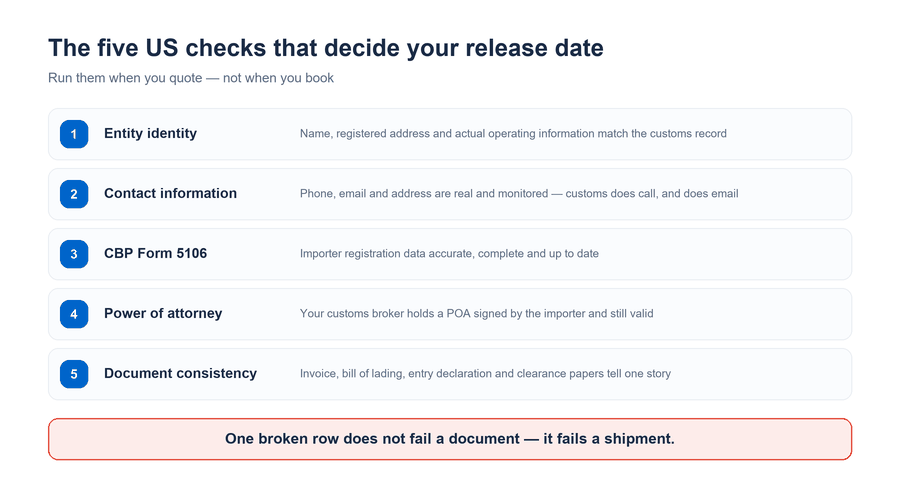 |
| One broken row does not fail a document — it fails a shipment. |
# | Check | What "compliant" actually looks like |
- | ----------------------- | ------------------------------------------------------------------------------------------------- |
1 | Entity identity | Name, registered address and actual operating information all match the customs record |
2 | Contact information | Phone, email and address are real and monitored — customs does call, and does email |
3 | CBP Form 5106 | Importer registration data accurate, complete and up to date |
4 | Power of attorney | Your customs broker holds a POA signed by the importer and still valid |
5 | Consistency | Commercial invoice, bill of lading, entry declaration and clearance documents tell a single story |
One broken row does not fail a document. It fails a shipment.
Run this check when you quote, not when you book. Finding a stale POA three weeks before sailing costs an email. Finding it three days after arrival costs demurrage, storage and credibility.
Trap #2 — Mexico: valuation is where the arguments start
Mexico's adjustment to its electronic customs valuation declaration raises the bar on what importers must demonstrate about the value of their goods. And unlike a purely administrative rule change, this one has teeth: customs valuation is the direct basis for the duties and taxes you owe, which is precisely why it gets examined.
For shipments into Mexico, three questions now decide your week:
Question | What customs is looking for |
Is the declared value accurate? | Commercial invoice, purchase contract and actual transaction price correspond to one another |
Is the transaction evidence complete? | Payment records, freight cost breakdowns and valuation-related support documents, where the declaration requires |
Was the process confirmed before departure? | Filing flow, submission method and the split of responsibility between importer and local broker, settled early |
Mexico is one of the lanes we live on — Manzanillo, Lázaro Cárdenas and Veracruz inbound, with DDP delivery inland to Mexico City, Guadalajara, Monterrey, Puebla and Tijuana. The single most common cause of delay we see is not an unfriendly customs officer. It is an invoice that disagrees with the payment record — discovered after the container is already at anchor.
Trap #3 — Europe: the slow change is the dangerous one
Europe looks gentler. There is no headline-grabbing crackdown, no sudden circular. Instead the EU is advancing a broader customs modernisation reform: unified data management, stronger risk identification, tighter supervision of e-commerce imports, better coordination between member states.
The purpose is simple to state and hard to satisfy: give customs a clearer picture of where goods flow, what they are worth, and who is accountable.
Two cautions, and they matter:
Area | What to keep clean right now |
Importer identity | Economic operator registration and identification data (EORI) verified and current |
Declarations | Goods description, HS code, declared value and country of origin all accurate |
Advance data | Current pre-arrival filing requirements, including the EU's ICS2 import control system |
E-commerce goods | Evolving rules on low-value consignments, platform liability and import supervision |
These are not theoretical lanes for us. STU Supply Chain moves cargo into all three of these markets every week — international ocean freight, air freight and destination-port customs clearance across the United States, Mexico and Europe — which is why we read rule changes like these as working documents rather than news items. Years in these trades teach you one thing quickly: the shipments that go wrong are almost never the ones that were priced wrong. They are the ones that were prepared wrong.
What a broken file actually costs
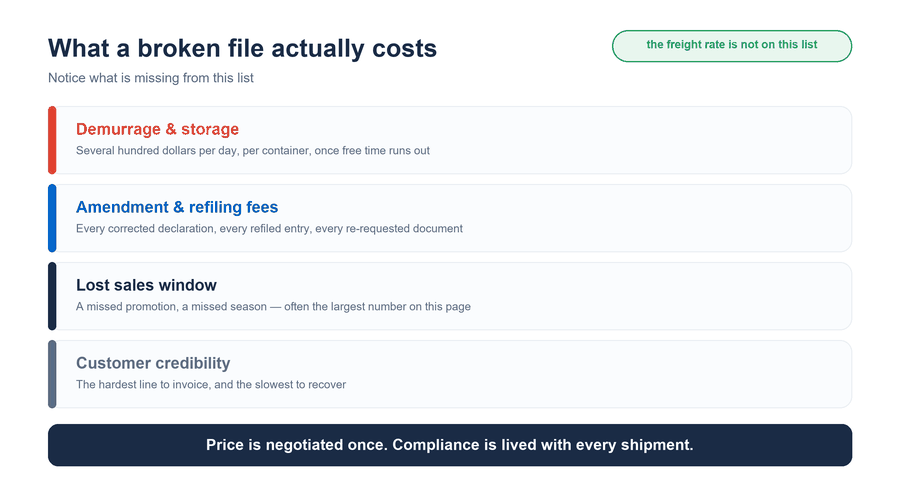 |
| Price is negotiated once. Compliance is lived with every shipment. |
Cost line | What it looks like in practice |
Demurrage and storage | Several hundred dollars per day, per container, once free time runs out |
Broker and amendment fees | Every corrected declaration, every refiled entry, every document re-requested |
Lost sales window | A missed promo, a missed season — often the largest number on this table |
Customer credibility | The hardest to invoice and the slowest to recover |
Compounding stress | Your team firefighting at the port instead of selling the next quarter |
Notice that the freight rate appears nowhere on this list. Price is what you negotiate once; compliance is what you live with every shipment.
The four habits that keep your containers moving
Verifying one document in advance can prevent one customs delay. Clarifying one responsibility in advance can prevent one dispute.
The 10-point pre-shipment file check
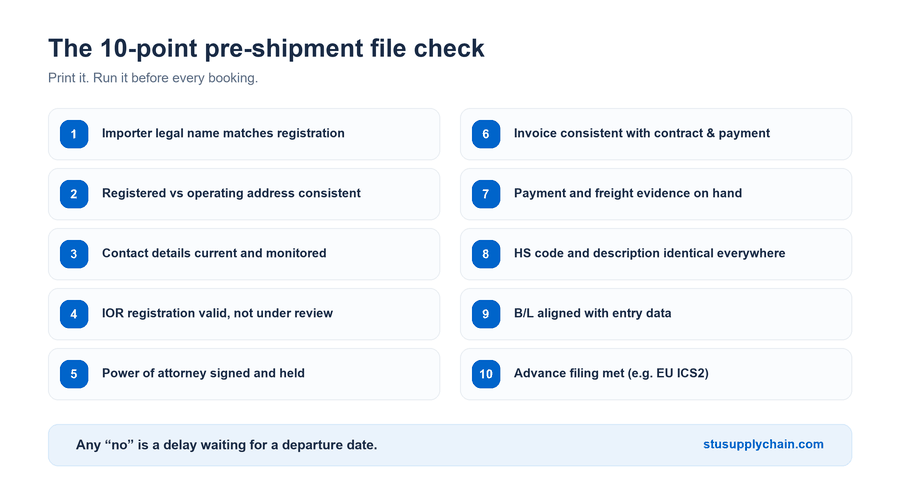 |
| Run this before every booking — any "no" is a delay waiting for a departure date. |
Print this page. Run it before every booking.
# | Item | The question to answer |
1 | Importer legal name | Matches the customs registration exactly? |
2 | Registered vs operating address | Consistent, and is any difference explainable? |
3 | Contact details | Phone and email current and monitored? |
4 | IOR / registration number | Valid, active, not under review? |
5 | Power of attorney | Signed by the importer, valid, held by the broker? |
6 | Commercial invoice | Consistent with contract and payment record? |
7 | Payment and freight evidence | Available if valuation is questioned? |
8 | HS code and goods description | Specific, accurate, and identical across all documents? |
9 | Bill of lading vs entry data | Consignee, notify party and descriptions aligned? |
10 | Advance filing requirement | Met for the destination lane and mode (e.g. EU ICS2)? |
Any "no" is a delay waiting for a departure date.
FAQ
What is an importer of record (IOR)?
The party legally responsible for importing the goods — the entity that files the entry, owes the duties and answers to customs. It is a legal responsibility, not a field you can borrow from a third party without proper authorisation.
What is CBP Form 5106?
The US form used to create or update an importer's record with customs: legal name, addresses, contacts and identification numbers. When those details change, or were entered inconsistently, the registration can be questioned.
Why is customs valuation so sensitive in Mexico?
Because valuation directly determines the duties and taxes owed. Invoice, contract and actual transaction price must align, and supporting documents — including payment and freight cost evidence — may be requested.
What is EU ICS2?
The EU's advance cargo information system, which requires specified consignment data to be filed before arrival. It is a live requirement today, separate from the broader customs reform still being phased in.
If I ship DDP, is customs still my problem?
It is still your risk. Under DDP a forwarder handles clearance and duties, but the importer of record and the underlying documents must still be valid. DDP does not repair a broken IOR file — it only postpones the discovery until the cargo has already arrived.
Where should I start if I only have ten minutes?
Run the 10-point check above on your next two bookings. If anything fails, fix it before the vessel sails, not after it berths.
If your cargo is already stuck, that is our daily work
Freight rates move every week and everyone watches them. Customs rules move more slowly, and almost nobody watches them — until a container stops moving and the invoices start.
In the US, Mexico and Europe the question has quietly shifted from *how much does it cost to ship* to *can this shipment be imported at all, on time, with the papers we have*. That is a capability, not a coincidence — and it is built before departure, not at the port.
STU Supply Chain has spent years in exactly these trades: international ocean freight, air freight and customs clearance at the destination port, with particular depth in the United States, Mexico and Europe. Anyone can book a sailing. What our customers stay for is knowing that the file behind the container holds up when it reaches customs.
We treat documentation and clearance as part of the shipment, not an afterthought — FCL and LCL ocean freight, air cargo, and DDP door-to-door from China to the USA, Canada, Europe, Mexico and Japan, plus Amazon FBA logistics and customs clearance. As a licensed NVOCC (MOC-NV09192) and FMC (030310) forwarder, we review the importer file, valuation support and declaration data before booking — so the surprises land in our inbox instead of at your terminal.
If a customs question is keeping you up at night, or you are stuck somewhere in the logistics chain right now, that is precisely the conversation we have every day. Contact STU Supply Chainwith your lane, the importer details and the goods description. We will tell you what your destination now requires, flag anything that looks thin — and quote the shipment, before anything sails.


Comments
Post a Comment