✈️ When Feathers Cost More Than Lead: Demystifying the "Ghost Weight" in Air Cargo
💡 The Panic Signal: A Soul-Searching Conversation
My shipment weighs exactly 50 kg on the scale! Why is my freight invoice charging me for 167 kg?! Are forwarders just inventing numbers to rip me off?
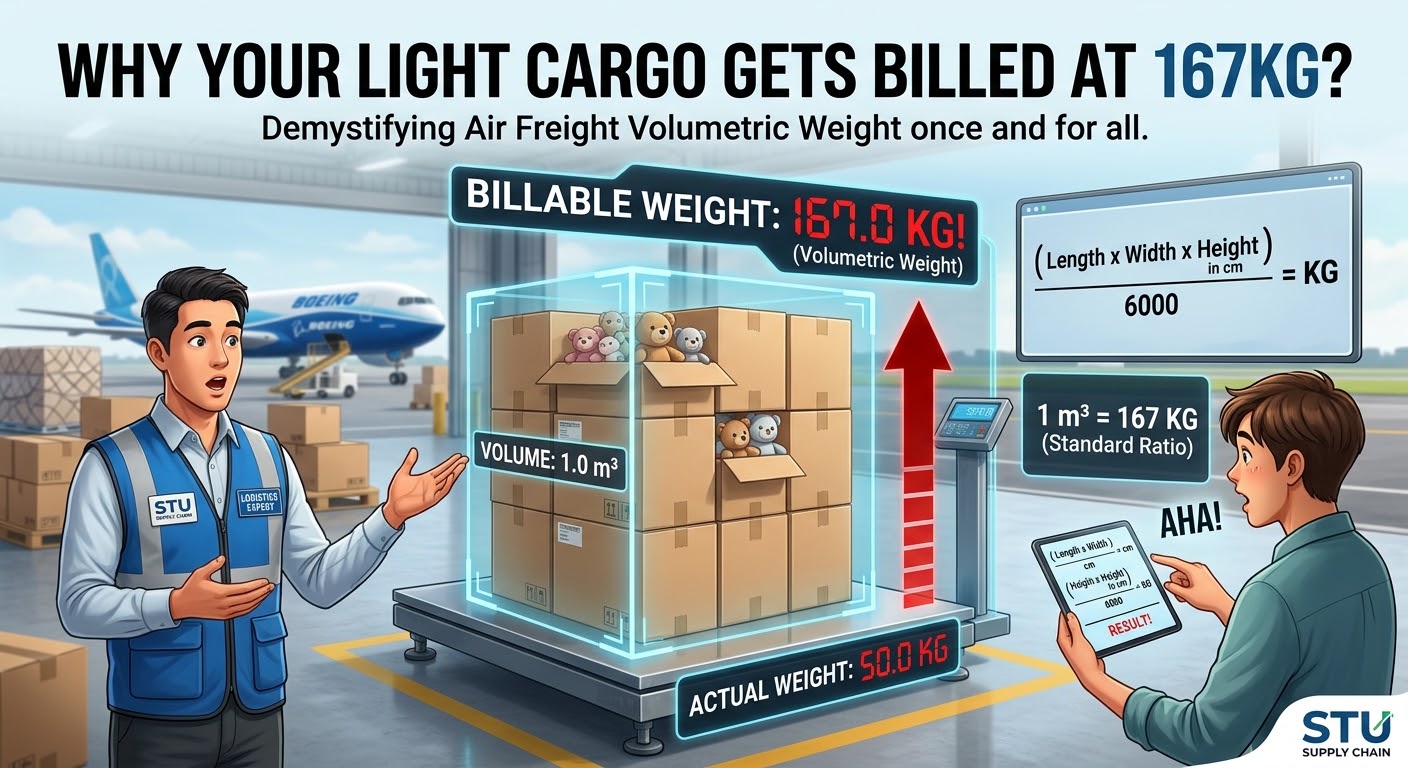
If you have ever imported goods, managed e-commerce inventory, or handled international logistics, this moment of pure, unadulterated outrage probably feels eerily familiar.
Welcome to the mysterious realm of **Volumetric Weight (Dimensional Weight)**—the invisible industry standard that leaves thousands of business owners scratching their heads every day.
Today, we are stripping away the confusing technical jargon to reveal the fascinating physics, economic logic, and secret arithmetic behind air freight pricing. By the time you finish reading, you won’t just understand your freight bills—you'll know how to outsmart them.
😲 Discovery 1: The Aircraft’s Claustrophobia & The Two Hard Ceilings
You might assume that shipping by sea and shipping by air follow similar rules. **Think again.**
Ocean Cargo is a Heavyweight Champion:** A container ship cares primarily about maximum weight limits. As long as your goods fit inside a 40-foot container and don't breach maximum payload rules, the captain couldn't care less whether you packed solid steel bars or styrofoam peanuts.
Air Freight Suffers from "Space Claustrophobia":** An airplane’s cargo bay operates under two ruthless, non-negotiable physical limits:
1. Maximum Payload Limit:The absolute maximum weight the aircraft's engines can lift safely.
2. Volume Capacity Limit:The physical cubic space available inside the belly hold.
💡 The Mind-Bending Scenario:
Imagine an airline that billed only by physical weight on a scale.
A seller books an entire Boeing 777 freighter and fills every cubic inch of the cargo hold with giant plush teddy bears. On the scale, the total shipment weighs a mere 1,000 kg. The airline charges $3,000 based on scale weight—yet the plane is 100% full, meaning no other high-value cargo can be loaded.
That single flight would cost the airline tens of thousands of dollars in lost revenue!**
To prevent this, the International Air Transport Association (IATA) established a universal rule: **Physical space inside a plane has monetary value. If your cargo occupies volume, you must pay for the "air" you are taking up.**
🧩 Discovery 2: Unraveling the Magic Numbers "167" and "÷6000"
If you've ever looked closely at an air freight quote, you’ve likely encountered two cryptic figures: **1:167** and **÷ 6000**. Where do these numbers come from?
It all stems from a universal standard conversion ratio:
✨ The Mathematical "Aha!" Moment:**
How does 1\text{ m}^3 = 167\text{ kg} turn into the famous **\div 6000** formula?
1. 1\text{ cubic meter (m}^3) = 1,000,000\text{ cubic centimeters (cm}^3).
2. Divide 1,000,000\text{ cm}^3 by 167\text{ kg}:
3. To simplify mental math for warehouse workers worldwide, IATA rounded 5,988 up to a clean, elegant **6000**!
*(Note: Express couriers like DHL, FedEx, and UPS often use \div 5000, assigning 1\text{ m}^3 an even higher volumetric weight of 200\text{ kg}.)*
So, when your shipment measures 1\text{ m}^3 but weighs only 50\text{ kg} on the scale, the airline doesn't see a 50\text{ kg} box. They see **167\text{ kg} of prime aviation real estate**—and that higher number becomes your **Chargeable Weight**.
🧠 Modern Insight: How to Explain This to Your Buyers
When a client or buyer accuses you of inflated freight quotes, don't throw complex math equations at them. Instead, use the **Penthouse Analogy**:
Think of an aircraft's cargo bay like a luxury high-rise apartment building. If your goods are lightweight but very bulky, they are renting a massive penthouse suite inside the plane. The airline charges rent based on floor space (volume), not just tenant weight on a scale!
This simple analogy transforms an argument from *"You're overcharging me"* into *"Ah, my shipment is occupying valuable penthouse space!"*
🛠 Actionable Strategy: 3 Ways to Defeat "Ghost Weight"
Since you can't change IATA's international aviation rules, how can you avoid paying for empty air? Here are three strategies used by logistics professionals:
1. **Vacuum Compression (Squeezing Out the Air):**
If you ship clothing, plush toys, bedding, or textiles, **vacuum sealing is mandatory**. E-commerce sellers have reduced shipment volumes from 10\text{ m}^3 down to 3\text{ m}^3 through vacuum packing, saving thousands of dollars on a single flight.
2. **Heavy-Light Hybrid Packing (The "CP" Combo):**
Never ship lightweight, bulky goods in isolation if you also ship dense products! Combine heavy cargo (machinery parts, hardware, tools) with light cargo (plastic housings, apparel) in the same shipment. The heavy weight balances out the volume, bringing your overall ratio closer to 1:1.
3. **Prevent "Box Bulge" (Outer Packaging Engineering):**
Airlines calculate volumetric weight based on the **outermost points** (\text{Length} \times \text{Width} \times \text{Height}). If an flimsy cardboard box bulges outward by just 3\text{ cm} on each side, your billable weight can jump significantly. Invest in rigid, double-walled, custom-fit cartons.
🌟 Conclusion
Logistics is never just about moving a box from Point A to Point B—it is a game of **spatial optimization, engineering, and cost management**.
The next time you see the number **167** on an air freight bill, you won't need to panic. You have unlocked the secret mechanics of air cargo and now hold the power to optimize your supply chain like a pro!


Comments
Post a Comment