🇺🇸 U.S. Customs Crackdown Alert: Avoid 5,000 Fines on "Ship To" Addresses
If you are shipping to the United States, you have likely noticed a significant shift in the landscape. U.S. Customs and Border Protection (CBP) has upgraded inspection protocols across all ports. Beyond the well-known issues of expired Importer Bonds, "5H" intensive exams, and cargo value verification, there is a new, critical area of focus: The authenticity of the "Ship To Address" in ISF (10+2) filings.
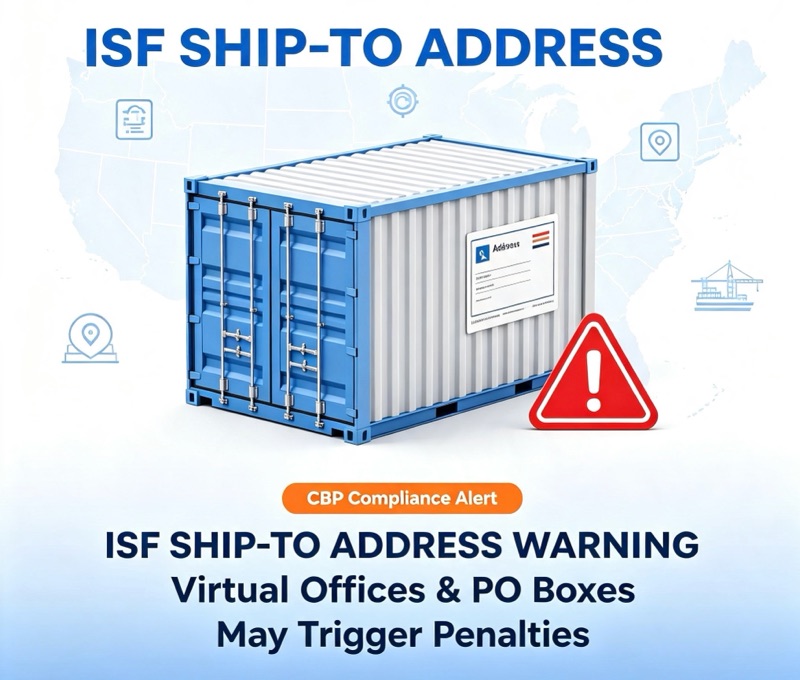
At STU Logistics, we have been deeply cultivating the U.S. market for many years. Our extensive experience in China-U.S. logistics operations has given us a front-row seat to these regulatory changes. To help you avoid unnecessary economic losses, we are issuing this urgent warning and providing professional solutions.
⚠️ Real-World Case Study: The Cost of a "Virtual" Address
We recently encountered a situation where a client received a 5,000 penalty from Customs. The cause? The "Ship-To" address listed in their ISF filing was a virtual office or P.O. Box.
According to 19 CFR 149.3, the Ship-To address must be a physical location where the container can be stopped and received after Customs release. Virtual addresses do not meet compliance requirements and are flagged as "Inaccurate Filing."
The Financial Impact:
1. Customs issues the fine to the Importer's Bond surety company.
2. The surety company seeks full reimbursement from the importer.
3. Result: The importer bears the entire loss.
📋 ISF Filing: Hard Compliance Requirements
To ensure your cargo clears customs smoothly, strict adherence to address guidelines is non-negotiable.
* 🚫 Prohibited: Virtual mailboxes, registered agent addresses, or P.O. Boxes.
* ✅ Required: Physical overseas warehouses, commercial warehouses, or actual business premises capable of receiving full container loads.
* 🤝 Partner Wisely: Choose U.S. importers with legitimate qualifications and good credit standing.
* 🔄 Update Immediately: If the收货地址 (consignee address) changes, update the ISF filing immediately. Do not take chances.
⚖️ Received a Penalty? Official Appeal Channels
If you have unfortunately received a Notice of Penalty, you have the right to seek relief. You can file an administrative petition online to strive for mitigation or cancellation of the claim.
* ⏳ Deadline: You must file within 60 calendar days of receiving the notice. Late filings are rejected.
* 👤 Who Files: The Importer, the Bond surety, or a customs broker acting on your behalf.
* 🌐 Official Platform: You can submit your petition via the CBP ePetition system: https://epet.cbp.dhs.gov/
Note: When filing a petition, you will need to provide contact information, facts justifying the mitigation, and supporting documents (such as proof of the actual delivery location).
🛡️ Proactive Defense: Stop Risks Before Shipping
While post-incident appeals are possible, the communication costs are high. The key to "silky smooth" customs clearance is ensuring information accuracy before the cargo leaves China.
At STU Logistics, we leverage our deep industry expertise to help you verify data early:
1. Importer Bond Pre-check: We verify the Bond type, effective dates, and status to prevent cargo holds upon arrival.
2. ABI Query Tracking: We utilize direct interfaces with the CBP ACE system to track release status, exam holds, and inland transit info via the Bill of Lading number.
3. Manifest Data Verification: We cross-reference the carrier's actual filing with your AMS/ISF data to ensure consistency and lower exam probabilities.
Don't let a simple address error cost you thousands. Contact STU Logistics today for professional China-U.S. logistics support. We are here to navigate these complex regulations for you.


Comments
Post a Comment