Hapag-Lloyd Suspends Ukraine Feeder Services; Two Major Liner Giants Successively Scale Back Black Sea Operations
Black Sea shipping operations for Ukrainian ports have undergone another major shift.
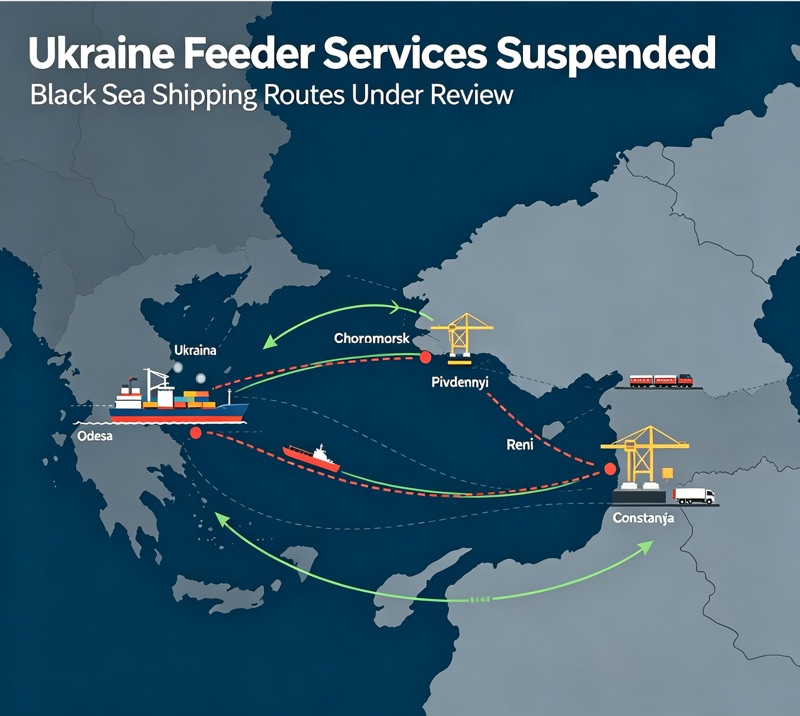
Citing the continuously deteriorating security situation across the Black Sea region, Hapag-Lloyd recently announced that its feeder carrier partners providing services to Ukraine have suspended all calls at Ukrainian Black Sea ports. The resumption timeline will be determined by follow-up security assessments and notified separately.
This marks another major operational adjustment to Ukraine-related services by a top global liner carrier, shortly after Maersk revised its cargo transport solutions for Ukraine. The move signals a fundamental restructuring of logistics arrangements throughout the Black Sea basin.
1. Feeder Services Halted at Three Key Black Sea Ports
Per Hapag-Lloyd’s customer advisory, vessel calls have been suspended at the following ports:
• Chornomorsk
• Odesa
• Pivdennyi
The carrier stated that cargo originally destined for the above ports will be diverted to alternative discharge terminals, with onward transportation to be rearranged based on actual operational conditions.
Hapag-Lloyd is prioritizing an assessment of Reni, a Ukrainian Danube port, as a substitute discharge hub. If Reni fails to meet shipping requirements, shipments may be rerouted to Romania or Poland, followed by overland haulage into Ukraine, subject to cargo specifications, transit schedules and client demands.
Hapag-Lloyd added that it will continuously monitor security risks and modify its transport schemes in line with evolving operating conditions.
2. Further Contraction of Ukraine’s Maritime Shipping Corridors
This is not Hapag-Lloyd’s first suspension of Ukrainian port services. Shortly after the outbreak of the Russia-Ukraine conflict in 2022, the carrier ceased all port calls in Ukraine. Partial Black Sea shipping resumed thereafter, and in May 2024, Hapag-Lloyd relaunched third-party-operated feeder routes deploying 1,100 TEU-class vessels between Romania’s Port of Constanța and Chornomorsk, primarily handling grain and sunflower oil exports.
Nevertheless, recent surging security hazards in the Black Sea, coupled with a sharp rise in Russian airstrikes targeting Ukrainian port infrastructure and adjacent vessels, have prompted the renewed feeder service suspension. The decision reflects liners’ updated risk evaluations for commercial operations.
Just one week prior, Maersk rolled out revised logistics solutions for Ukraine, diverting volumes originally bound for Ukrainian seaports to Romanian terminals for cross-border land transport into Ukraine.
The successive operational revisions by these two leading global shipping lines indicate that Ukraine’s supply chain is shifting away from direct Black Sea port calls toward alternative transit models centered on Romanian hubs, Danube river ports and cross-border overland links.
3. Restructuring of Black Sea Logistics Networks
In the short term, this adjustment only reshapes transit workflows for Ukraine-bound cargo, without impacting full European liner services overall.
For Ukrainian exporters and international freight forwarders, key action items include tracking carriers’ updated port rotation and destination revisions, and confirming in advance whether cargo will require port diversion or transit route reconfiguration.
In addition, intermodal sea-land transport will grow increasingly critical. Transshipment via Romanian seaports, Danube terminals and Polish border crossings to reach Ukraine is projected to remain the dominant transit model for the foreseeable future.
Moreover, transit lead times, inland haulage costs and war risk surcharges are likely to fluctuate in response to regional security volatility. Industry stakeholders should closely monitor carrier advisories and local port operational status to optimize shipment planning.
Ukrainian authorities maintain that Black Sea ports remain officially open. However, persistent security threats mean international liner operators may continue revising their route strategies as field conditions evolve. For logistics enterprises reliant on Ukrainian trade, real-time tracking of carrier policy updates and alternative transit solutions is critical to safeguarding supply chain resilience.


Comments
Post a Comment