CBP Purges 4.8 Million Dormant IOR Accounts: New US Shipping Mandate Requires Active IOR & CTPAT Validated Brokers for Foreign Shippers, or ACE Entry Filings Will Be Rejected
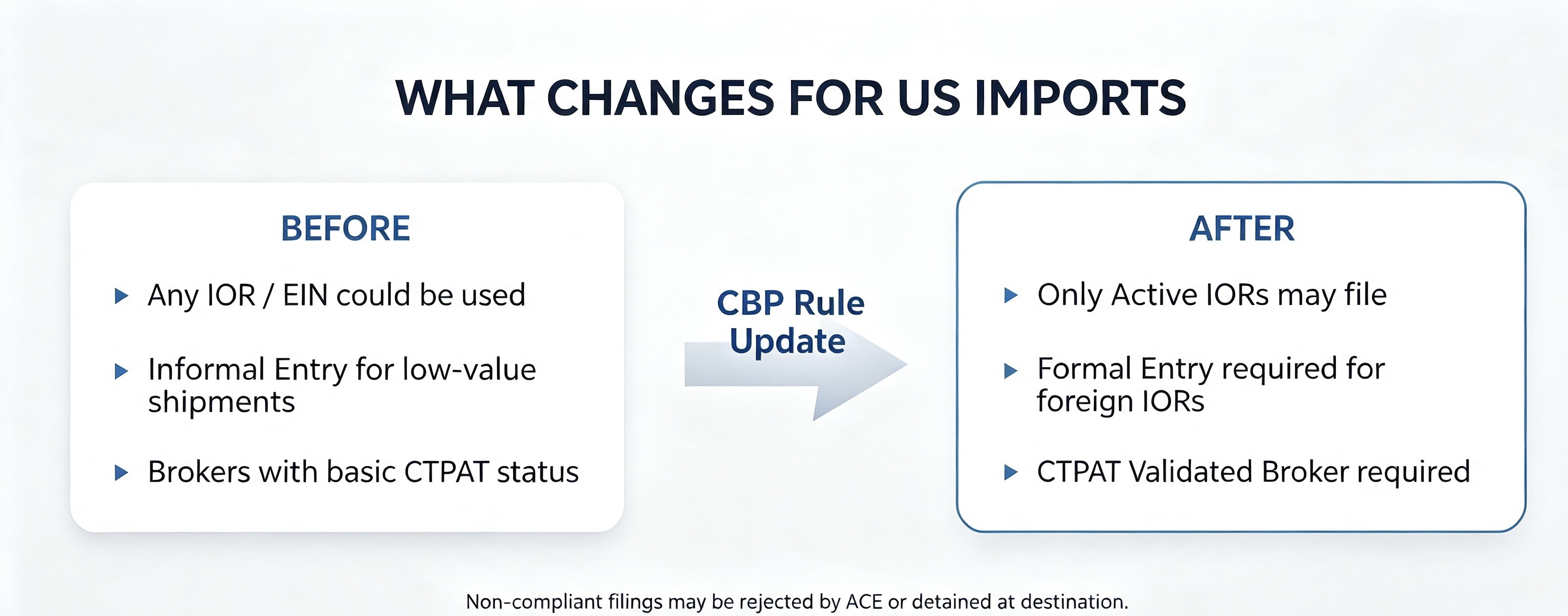
Issued in June 2026, Executive Order 14411 titled Strengthening Customs Enforcement has triggered sweeping compliance reforms rolled out by U.S. Customs and Border Protection (CBP). On July 16, CBP activated the new status "Inactive for Entry Purposes" within the Automated Commercial Environment (ACE) platform, automatically flagging roughly 4.8 million Importer of Record (IOR) accounts that had zero import entry filings over the prior 12 months as invalid. Full enforcement took effect in August 2026, delivering severe disruptions to Chinese cross-border merchants, overseas traders relying on foreign IORs, U.S. shell entities and shared third-party IOR identities. Submitting bookings or customs clearance documents via deactivated IOR numbers will result in immediate ACE rejection of ISF and AMS filings, with shipments subject to port detention upon arrival in the U.S.
1. Four Core Regulatory Overhauls All Freight Forwarders & Cross-Border Operators Must Master
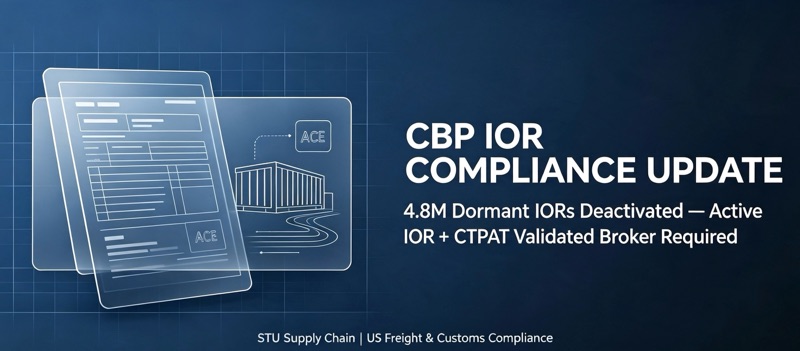
1. Mass Deactivation of 4.8 Million Dormant IORs with Rigorous Reactivation Standards
Any IOR lacking a single import entry filing in a full calendar year is automatically labeled "Inactive" and locked out of all customs filing workflows. To restore eligibility, importers must complete a full reactivation audit through ACE, submitting comprehensive beneficial ownership disclosure, tangible U.S. domestic asset proof, and supporting CTPAT affiliation documentation. The lengthy review timeline leaves little room for emergency cargo shipments.
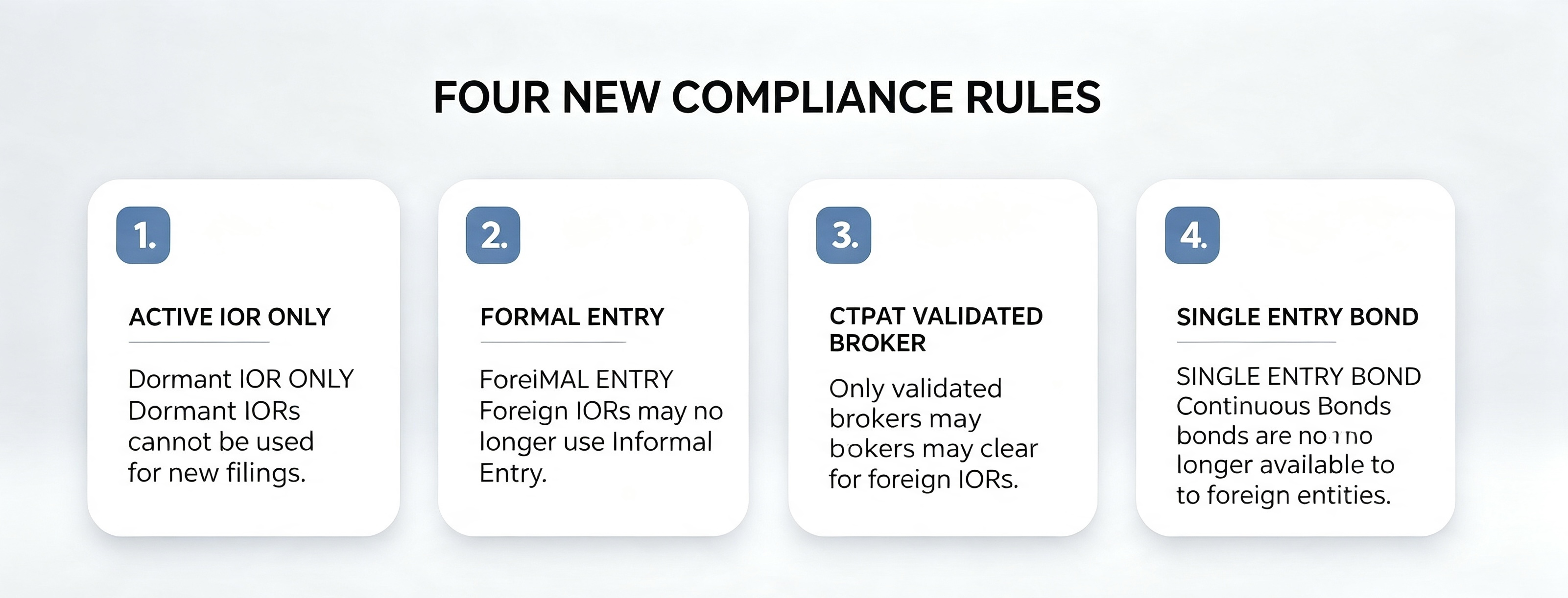
2. Four Mandatory Compliance Restrictions Exclusively for Foreign IORs, Obsoleting Traditional Clearance Models
• Informal Entry (cargo valued ≤ USD 2,500) is permanently closed to foreign IORs; all shipments must undergo full Formal Entry formalities.
• Customs brokers must hold both a federal Licensed Broker credential and CTPAT Validated on-site verification certification. Brokers only holding basic CTPAT Certified accreditation are disqualified from clearing goods for foreign IORs.
• Continuous Annual Customs Bonds are no longer accessible to foreign entities. All shipments under foreign IORs require separate Single Entry Bonds per shipment, driving up recurring logistics expenses.
• Continuous deep-dive audits of underlying beneficial ownership structures are enforced; IORs controlled by offshore entities with no physical U.S. presence face drastically elevated inspection rates.
3. Dual Penalty Mechanism: 2R Do Not Load at Origin & 9H Importer Detention at Destination Ports
Violations including inactive IORs, mismatched data across ISF/AMS/bills of lading, expired bonds, or shared shell IOR identities will trigger a 2R Do Not Load ban at loading ports, prohibiting container loading onto vessels. If shipments depart despite non-compliance, cargo will be flagged for 9H importer eligibility detention upon reaching U.S. terminals.
4. Mandatory Designated Drayage Rule for 10X Inspections at Oakland Port Effective July 27
Containers selected for 10X multi-layer examinations (trade compliance, PGA regulatory screening, agricultural quarantine) at Oakland Port lose the right to shipper-selected drayage carriers. CES-contracted haulers are assigned exclusively by customs authorities, with unforeseen surcharges for drayage, storage and detention fully borne by the cargo shipper.
2. Severe Industry Disruptions Triggered by the New CBP Mandate
1. Third-Party U.S. Shell IOR Arrangements Are No Longer Viable
Countless cross-border e-commerce sellers previously used U.S. individual EINs or idle shell corporations as proxy IORs to operate DDP door-to-door clearance services. Most of these accounts carry zero annual filing activity and will be flagged inactive en masse in August. Replacing valid IOR identities after SI cutoff deadlines leads to missed vessel cutoffs and costly 2R loading bans.
2. Low-Cost DDP All-In Clearance Channels Lose Compliance Groundwork
Budget U.S. all-in shipping rates historically relied on three cost-saving levers: foreign IOR identities, non-Validated CTPAT brokers, and annual Continuous Bonds. All three pillars now violate updated CBP rules. Continuing legacy clearance workflows exposes operators to joint liability for customs fraud, substantial fines, and cargo seizure.
3. Exponential Cost Escalation for Non-Compliant Shipments
If inactive IOR risks are identified at origin ports, remediation is limited to IOR substitution and revised ISF filings with minimal overhead. Shipments that reach U.S. ports and incur 9H detention alongside mandatory 10X inspections incur combined surcharges of USD 1,500–3,000 per container, covering IOR amendment fees, ISF refiling charges, CES drayage markups, terminal storage and detention penalties.
3. Four Actionable Compliance Strategies for U.S.-Bound Freight Forwarders & Exporters
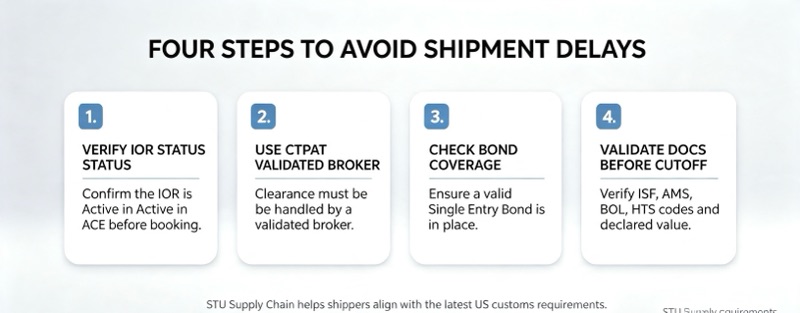
Conduct a full audit of all active client IOR accounts immediately to avoid a wave of clearance failures in late August:
1. Pre-Shipment Eligibility Checks for All IOR Identities
Authorize licensed U.S. customs brokers to verify every operational IOR’s live ACE status. For any "Inactive" flagged accounts, notify clients to initiate formal reactivation or source an alternative IOR with consistent filing history well before SI booking cutoffs, eliminating 2R Do Not Load risks upfront.
2. Phase Out Partnerships with Non-CTPAT Validated Customs Brokers
Vet all clearance partners to obtain both federal broker license numbers and official CTPAT Validated certification credentials; discontinue cooperation with solely CTPAT Certified providers. Explicitly state on all client quotations: clearance handled by CTPAT Validated licensed brokers, fully compliant for foreign IOR shipments.
3. Restructure IOR Entities & Clarify Liability via Shipping Contracts
Encourage DDP clients to establish U.S.-based subsidiaries or domestic warehouse entities as compliant primary IORs, or restructure trade terms to FOB/EXW to shift clearance obligations to U.S. buyers. Insert contractual liability clauses stipulating all additional charges stemming from dormant IORs, invalid bonds, or unqualified brokers (including 2R bans, 9H detention and 10X inspection fees) are chargeable to the shipper, with freight forwarders authorized to deduct losses from freight balances or security deposits.
4. Three-Way Document Validation Prior to SI Cutoff to Mitigate Risk at Origin
Implement standardized pre-cutoff triple verification workflows covering: live IOR status, consistent HTS codes, commodity descriptions and declared values across ISF/AMS/BOL, and unexpired customs bond coverage. Hold off on carrier filing submissions if any discrepancy is detected to block non-compliant cargo before vessel loading.
This analysis is compiled from official CBP CSMS circulars and real-world operational feedback from U.S. gateway ports, provided solely for industry compliance reference. All businesses should adjust clearance protocols based on individual cargo volume and supply chain structures.


Comments
Post a Comment