Asian Ports Suffering Severe Congestion & Vessel Delays, US Liner Freight Rates Surge Sharply While European Lanes Stay Weak
August 5, 2026 — Major ports across Asia are plagued by operational bottlenecks and widespread schedule disruptions recently. A large volume of cargo originally scheduled for July shipment has been pushed back to August. Coupled with intentional capacity cuts by major carriers, container freight rates on Westbound and Eastbound US lanes have skyrocketed, forming a divergent market landscape for container shipping.
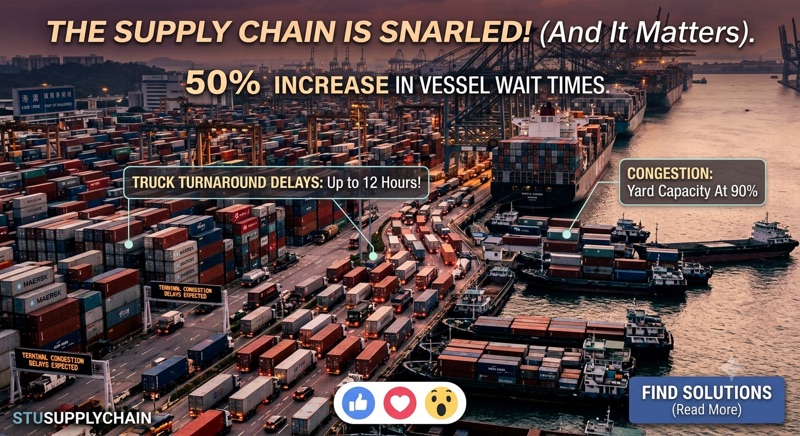
Disrupted by adverse weather conditions, vessels calling at Shanghai and Ningbo Ports face delays of 3 to 5 days on average. Shipping schedules at Singapore, Malaysia and other Southeast Asian ports are also set back by around 3 days, dragging down vessel on-time performance. Massive cargo backlogs, carriers’ capacity control via blank sailings and space allocation limits, as well as restricted transit capacity at the Panama Canal limiting loading volumes of large vessels bound for US East Coast, jointly fuel the rally of US ocean freight rates.
SCFI Rebounds Sharply, US Lanes Jump Over 12% Week-on-Week
The Shanghai Containerized Freight Index (SCFI) released by Shanghai Shipping Exchange on July 31 closed at 3,205.97 points, rising 143.02 points or 4.67% week-on-week, putting an end to three consecutive weeks of decline.
Freight rates varied drastically across different trade lanes:
1. US lanes lead the market rally: 40ft FEU rates to US West Coast hit USD 6,229, up USD 694 or 12.53% week-on-week; rates to US East Coast reached USD 9,054 per FEU, surging USD 1,014 with a 12.61% weekly growth, serving as the core driver lifting the index. Multiple carriers implemented rate hikes starting August 1. MSC plans to lift US East Coast rates to USD 10,500 per 40ft container and raise US West Coast rates by USD 300 to USD 6,500. Maersk adopted milder adjustment, quoting around USD 8,740 for US East Coast and USD 6,460 for US West Coast, resulting in uneven implementation across the industry. Analysts predict rate hikes are more likely to hold on US East Coast due to tight supply-demand balance, while sustainability of price rises on US West Coast remains uncertain amid new capacity inflows.
2. European lanes remain under pressure: Rates for Far East-Europe service stood at USD 3,039 per TEU, dropping USD 116 or 3.67% week-on-week; Far East-Mediterranean rates settled at USD 4,189 per TEU, down USD 162 or 3.72%. No unified industry-wide rate increase has been announced for August, with spot prices edging down. Current spot quotations for 40ft containers to Europe range from USD 4,900–5,000 for OA Alliance and USD 4,400–4,600 for PA Alliance.
3. Mixed performance of other lanes: Freight rates to Persian Gulf and South America climbed; rates for Australia & New Zealand dipped slightly; near-sea lanes to Southeast Asia and South Korea saw moderate growth, while Japan routes stayed flat.
Key Factors Shaping Future Market Trends
Capacity data reveals 8 blank sailings are scheduled for US lanes in the coming week, one more than the prior week, which will slightly expand available vessel space and narrow freight rate volatility. Only 3 blank sailings are arranged for Europe lanes, indicating looser capacity management and suggesting sideways price movement in the short run.
The current uptick in US freight rates stems from three core drivers: temporary space shortage caused by Asian port congestion, reduced loading capacity of large vessels due to Panama Canal transit limits, and peak-season stocking demand for North American year-end sales. However, upside momentum is capped by growing blank sailings and continuous delivery of new container ships; the sustainability of rate hikes fully hinges on actual cargo shipment volumes.
Geopolitical tensions in the Red Sea and Persian Gulf persist, keeping fuel costs and maritime risk premiums at elevated levels and further lifting overall export logistics expenses.
Practical Guidance for Shippers
August’s container shipping market will be determined by three core variables: the pace of congestion relief at Asian major ports, execution of carriers’ blank sailing and space control plans, and market acceptance of US lane rate hikes. Exporters and freight forwarders need to track port operations, vessel schedules and freight rate fluctuations in real time, arrange shipment schedules in advance, and mitigate dual risks of rising rates and cargo rollovers.
One-Stop Global Sea Freight Solution from STU Supply Chain
Against the volatile shipping landscape featuring port congestion, drastic freight swings and unstable vessel schedules, partnering with a resourceful and reliable logistics provider effectively minimizes supply chain risks. STU Supply Chain delivers all-in-one global ocean freight services for all foreign trade enterprises.
As a licensed NVOCC and FMC operator, and a certified member of WCA and WIFFA, STU maintains service networks covering all major loading ports in China including Shenzhen, Shanghai, Ningbo, Guangzhou, Qingdao, Xiamen and Hong Kong. We maintain long-term direct cooperation with top carriers including MSC, Maersk, COSCO Shipping, ONE and CMA CGM, securing stable space allocation for US West, US East and European lanes to tackle booking shortages triggered by port congestion and capacity control.
Our comprehensive ocean freight portfolio includes:
1. Full Container Load (FCL), Less than Container Load (LCL), breakbulk, open-top, flat rack and reefer container shipping;
2. Door-to-door DDP dedicated lines to US, Canada and Europe, Amazon FBA first-mile delivery and cross-border e-commerce logistics;
3. Factory cargo pickup, warehousing & consolidation, full import & export customs clearance and document processing;
4. Customized shipping plans for out-of-gauge (OOG) project cargo, dangerous goods and temperature-controlled products;
5. Intermodal sea-air and sea-rail combined transport to provide alternative shipment solutions amid vessel delays.
Backed by a worldwide network of overseas agents, STU updates real-time intelligence on overseas port congestion and local customs policies, proactively forecasting schedule disruptions and offering alternative sailing options. Our 24/7 dedicated customer support delivers fully transparent pricing with no hidden surcharges, priority space locking during peak seasons, and comprehensive risk mitigation against freight hikes and port congestion for global exporters. Whether you require shipments bound for the US, Europe, Southeast Asia, Middle East, South America or other regions worldwide, contact STU for customized optimal freight quotations and tailored shipment plans.


Comments
Post a Comment