AI Reshapes the Fortune Global 500: Corporate "Scale" No Longer Equals "Strength"
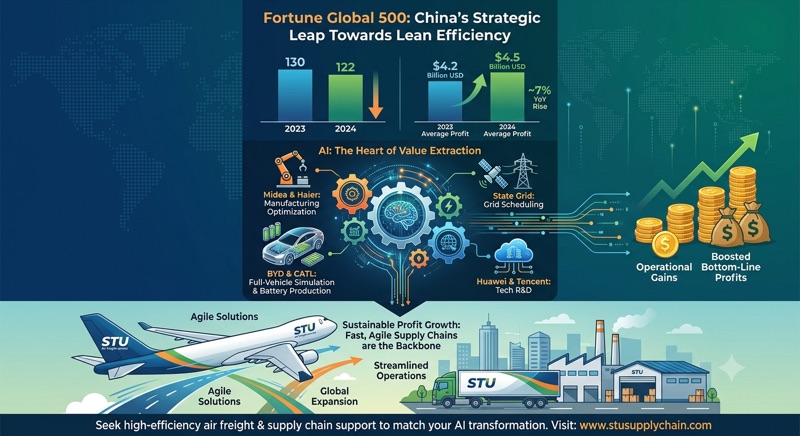
The latest Fortune Global 500 ranking reveals a set of seemingly contradictory figures for Chinese enterprises. Including companies from Taiwan, China, a total of 122 Chinese firms made the list – 8 fewer than last year. Yet the average profit of mainland Chinese and Hong Kong-listed corporations jumped from USD 4.2 billion to USD 4.5 billion, marking a roughly 7% year-on-year rise.

Fewer enterprises on the ranking, yet higher average profitability. Does this signal a retreat, or a strategic leap forward for China’s large conglomerates?
The underlying shift is clear: the old growth model reliant on massive asset expansion, overcapacity building and revenue inflation is being phased out.
Back in 2001, when China joined the WTO, only 11 domestic enterprises secured a spot on the Global 500 list. Over the following two decades, urbanization, global trade integration and manufacturing boom fueled unprecedented expansion for Chinese businesses. Between 2020 and 2022, the number of mainland and Hong Kong enterprises on the ranking even surpassed that of the United States.
Today, however, the entry threshold for the list has climbed to USD 33.2 billion in annual revenue. Across all 500 ranked companies, profit growth has vastly outpaced revenue expansion. Competition among industry giants has shifted from chasing sheer sales volume to maximizing value extracted from every dollar of revenue – and artificial intelligence stands at the heart of this transformation.
Data underscores AI’s transformative power: across 38 global intelligent tech firms, average revenue climbed 21% over three years, while average profit surged by an impressive 71%. For leading Chinese tech players including Huawei, Tencent, Lenovo, Xiaomi, Luxshare Precision and China Electronics, combined revenue rose nearly 30% across four years, with aggregate profit growing 41%.
Crucially, AI’s influence is no longer confined to tech firms’ product launches. BYD and CATL deploy vertical AI models for full-vehicle simulation and battery manufacturing optimization. Midea and Haier integrate AI across R&D, production lines, quality inspection and end-to-end supply chain management. State Grid leverages large language AI models for power grid scheduling, equipment maintenance and customer support.
These enterprises do not simply generate standalone "AI revenue streams". Instead, they unlock hidden operational gains: streamlined R&D cycles, reduced defective output on production floors, slashed warehouse inventory overheads – all of which boost bottom-line profits within their core existing businesses.
Of course, AI cannot take sole credit for rising average corporate profits. The composition of ranked enterprises has shifted significantly this year. Sixty-six mainland and Hong Kong companies slid down the rankings, while 10 reported net losses. Many AI rollouts also remain purely demonstrative, failing to deliver tangible financial returns.
The core takeaway from this year’s Global 500 ranking is not whether enterprises should keep expanding in size, but how to build lasting competitiveness after reaching scale. The next round of rivalry among the world’s top corporations will unfold not just in ranking tables, but on every production line, inside every logistics warehouse, and within every cost spreadsheet.
As enterprises streamline operations and pursue efficient global expansion, reliable cross-border logistics becomes an irreplaceable pillar of sustainable profit growth. STU Air freight service delivers agile, cost-optimized air cargo solutions tailored for manufacturing, tech and large enterprise supply chains, helping businesses cut transit lead times and trim global logistics overheads to amplify operational margins.
If you are seeking high-efficiency air freight support and end-to-end supply chain consulting to match your company’s AI-driven lean transformation, visit our official website: www.stusupplychain.com


Comments
Post a Comment